5G redCap
- The maximum bandwidth is 20 MHz for FR1 and is 100 MHz for FR2. UE features and corresponding capabilities related to UE bandwidths wider than 20 MHz in FR1 or wider than 100 MHz in FR2 are not supported by RedCap UEs;
- The maximum mandatory supported DRB number is 8;
- The mandatory supported PDCP SN length is 12 bits while 18 bits being optional;
- The mandatory supported RLC AM SN length is 12 bits while 18 bits being optional;
- For FR1, 1 DL MIMO layer if 1 Rx branch is supported, and 2 DL MIMO layers if 2 Rx branches are supported;
for FR2, either 1 or 2 DL MIMO layers can be supported, while 2 Rx branches are always supported. For FR1 and FR2, UE features and corresponding capabilities related to more than 2 UE Rx branches or more than 2 DL MIMO layers, as well as UE features and capabilities related to more than 1 UE Tx branch, or more than 1 UL MIMO layer are not supported by RedCap UEs;
- CA, MR-DC, DAPS, CPAC and IAB (i.e., the RedCap UE is not expected to act as IAB node) related UE features and corresponding capabilities are not supported by RedCap UEs. All other feature groups or components of the feature groups as captured in TR 38.822 [24] as well as capabilities specified in this specification remain applicable for RedCap UEs same as non-RedCap UEs, unless indicated otherwise.
- Maximum FR1 RedCap UE bandwidth is 20 MHz;
- Maximum FR2 RedCap UE bandwidth is 100 MHz;
- Support of RedCap early indication based on Msg1, MsgA (if UE indicated support of twoStepRACH-r16) and Msg3 for random access;
- Separate initial UL BWP for RedCap UEs;
- It includes the configuration(s) needed for RedCap UE to perform random access
- Enabling/disabling of frequency hopping for common PUCCH resources
- Separate initial DL BWP for RedCap UEs;
- It includes CSS/CORESET for random access
- For separate initial DL BWP used for paging, CD-SSB is included
- For separate initial DL BWP only used for RACH, SSB may or may not be included
- For separate initial DL BWP used in connected mode as BWP#0 configuration option 1, CD-SSB is included
- 1 UE-specific RRC configured DL BWP per carrier;
- 1 UE-specific RRC configured UL BWP per carrier;
- UE-specific RRC-configured DL BWP with CD-SSB or NCD-SSB;
- NCD-SSB based measurements in RRC-configured DL BWP.
A RedCap UE shall set the field to supported.
BandNR parameters
Indicates support of RRC-configured DL BWP without CD-SSB or NCD-SSB. The UE can include this field only if the UE supports supportOfRedCap-r17.
- For MSG3/MSGA, a RedCap UE is identified by the dedicated LCID(s) indicated for CCCH identification (CCCH or CCCH1) regardless of whether RedCap specific Random-Access configuration is configured by the network.
- RedCap UEs with 1 Rx branch and 2 Rx branches can be allowed separately via system information. In addition, RedCap UEs in Half-Duplex FDD mode can be allowed via system information.
NOTE: It is up to the E-UTRA network, if possible, to avoid handover attempts of a RedCap UE to a target NR cell not supporting RedCap. It is up to the RedCap UE implementation, if possible, to recover from handover attempts to a target NR cell not supporting RedCap.
A RedCap UE may be configured with multiple NCD-SSBs provided that each BWP is configured with at most one SSB. NCD-SSB may be configured for a RedCap UE in RRC_CONNECTED to perform RLM, BFD, and RRM measurements and RA resource selection when the active BWP does not contain CD-SSB.
- An NR RedCap UE using NR shall provide an NR RedCap indication to the NG-RAN during RRC Connection Establishment procedure as defined in TS 38.300 [27].
- When the UE has provided an NR RedCap indication to the NG-RAN during RRC Connection Establishment, the NGRAN shall provide an NR RedCap Indication to the AMF in the Initial UE Message (see clause 4.2.2.2.1 of TS 23.502 [3] and TS 38.413 [34]).
1:30 PM
Definition of RedCap UE
A RedCap UE has reduced capabilities with the intention to have lower complexity with respect to non-RedCap UEs RedCap UE is the UE with reduced capability:- The maximum bandwidth is 20 MHz for FR1 and is 100 MHz for FR2. UE features and corresponding capabilities related to UE bandwidths wider than 20 MHz in FR1 or wider than 100 MHz in FR2 are not supported by RedCap UEs;
- The maximum mandatory supported DRB number is 8;
- The mandatory supported PDCP SN length is 12 bits while 18 bits being optional;
- The mandatory supported RLC AM SN length is 12 bits while 18 bits being optional;
- For FR1, 1 DL MIMO layer if 1 Rx branch is supported, and 2 DL MIMO layers if 2 Rx branches are supported;
for FR2, either 1 or 2 DL MIMO layers can be supported, while 2 Rx branches are always supported. For FR1 and FR2, UE features and corresponding capabilities related to more than 2 UE Rx branches or more than 2 DL MIMO layers, as well as UE features and capabilities related to more than 1 UE Tx branch, or more than 1 UL MIMO layer are not supported by RedCap UEs;
- CA, MR-DC, DAPS, CPAC and IAB (i.e., the RedCap UE is not expected to act as IAB node) related UE features and corresponding capabilities are not supported by RedCap UEs. All other feature groups or components of the feature groups as captured in TR 38.822 [24] as well as capabilities specified in this specification remain applicable for RedCap UEs same as non-RedCap UEs, unless indicated otherwise.
General parameters
ncd-SSB-ForRedCapInitialBWP-SDT-r17
Indicates that the UE supports using RedCap-specific initial DL BWP associated with NCD-SSB for SDT. If absent, the UE only supports SDT in an initial DL BWP that includes the CD-SSB. UE supporting this feature shall indicate support of supportOfRedCap-r17 and ra-SDT-r17 and/or cg-SDT-r17.supportOf16DRB-RedCap-r17
Indicates whether the RedCap UE supports 16 DRBs. This capability is only applicable for RedCap UEs.supportOfRedCap-r17
Indicates that the UE is a RedCap UE with comprised of at least the following functional components:- Maximum FR1 RedCap UE bandwidth is 20 MHz;
- Maximum FR2 RedCap UE bandwidth is 100 MHz;
- Support of RedCap early indication based on Msg1, MsgA (if UE indicated support of twoStepRACH-r16) and Msg3 for random access;
- Separate initial UL BWP for RedCap UEs;
- It includes the configuration(s) needed for RedCap UE to perform random access
- Enabling/disabling of frequency hopping for common PUCCH resources
- Separate initial DL BWP for RedCap UEs;
- It includes CSS/CORESET for random access
- For separate initial DL BWP used for paging, CD-SSB is included
- For separate initial DL BWP only used for RACH, SSB may or may not be included
- For separate initial DL BWP used in connected mode as BWP#0 configuration option 1, CD-SSB is included
- 1 UE-specific RRC configured DL BWP per carrier;
- 1 UE-specific RRC configured UL BWP per carrier;
- UE-specific RRC-configured DL BWP with CD-SSB or NCD-SSB;
- NCD-SSB based measurements in RRC-configured DL BWP.
A RedCap UE shall set the field to supported.
PDCP parameters
longSN-RedCap-r17
Indicates whether the RedCap UE supports 18-bit length of PDCP sequence number. This capability is only applicable for RedCap UEs.RLC parameters
am-WithLongSN-RedCap-r17
Indicates whether the RedCap UE supports AM DRB with 18-bit length of RLC sequence number. This capability is only applicable for RedCap UEs.MeasAndMobParameters
rrm-RelaxationRRC-ConnectedRedCap-r17
Indicates whether UE supports Rel-17 relaxed RRM measurements in RRC_CONNECTED as specified in TS 38.331 [9].Physical layer parameters
BandNR parameters
bwp-WithoutCD-SSB-OrNCD-SSB-RedCap-r17
Indicates support of RRC-configured DL BWP without CD-SSB or NCD-SSB. The UE can include this field only if the UE supports supportOfRedCap-r17. halfDuplexFDD-TypeA-RedCap-r17
Indicates support of Half-duplex FDD operation (instead of full-duplex FDD operation) type A for RedCap UE. The UE can include this field only if the UE supports supportOfRedCap-r17.Identification, access and camping restrictions
- A RedCap UE can be identified by the network during Random Access procedure via MSG3/MSGA from a RedCap specific LCID(s) and optionally via MSG1/MSGA (PRACH occasion or PRACH preamble). For RedCap UE identification via MSG1/MSGA, RedCap specific Random-Access configuration may be configured by the network.- For MSG3/MSGA, a RedCap UE is identified by the dedicated LCID(s) indicated for CCCH identification (CCCH or CCCH1) regardless of whether RedCap specific Random-Access configuration is configured by the network.
- RedCap UEs with 1 Rx branch and 2 Rx branches can be allowed separately via system information. In addition, RedCap UEs in Half-Duplex FDD mode can be allowed via system information.
- A RedCap specific IFRI can be provided in SIB1, when absent, RedCap UEs access is not allowed. Information on which frequencies RedCap UE access is allowed can be provided in system information.
- A RedCap UE with 1 Rx branch applies the associated offset for broadcasted cell specific RSRP thresholds for random access, SDT, cell edge condition and cell (re)selection criterion as specified in TS 38.133 [13].
- A RedCap UE with 1 Rx branch applies the associated offset for broadcasted cell specific RSRP thresholds for random access, SDT, cell edge condition and cell (re)selection criterion as specified in TS 38.133 [13].
NOTE: It is up to the E-UTRA network, if possible, to avoid handover attempts of a RedCap UE to a target NR cell not supporting RedCap. It is up to the RedCap UE implementation, if possible, to recover from handover attempts to a target NR cell not supporting RedCap.
RRM measurement relaxations
RRM measurement relaxation is enabled and disabled by the network. In RRC_IDLE and RRC_INACTIVE a RedCap UE is allowed to relax neighbor cell RRM measurements when the stationary criterion is met or when both stationary criterion and not-at-cell-edge criterion are met. Network may configure stationary criterion for a RedCap UE in RRC_CONNECTED and the UE reports its RRM measurement relaxation fulfilment status using UE Assistance Information when the stationarity criterion is met or no longer met.BWP operation
A RedCap UE in RRC_IDLE or RRC_INACTIVE monitors paging only in an initial BWP (default or RedCap specific) associated with CD-SSB and performs cell (re-)selection and related measurements on the CD-SSB. If a RedCap specific initial UL BWP is configured and NUL is selected, RedCap UEs in RRC_IDLE and RRC_INACTIVE shall use only the RedCap-specific initial UL BWP to perform RACH.A RedCap UE may be configured with multiple NCD-SSBs provided that each BWP is configured with at most one SSB. NCD-SSB may be configured for a RedCap UE in RRC_CONNECTED to perform RLM, BFD, and RRM measurements and RA resource selection when the active BWP does not contain CD-SSB.
NR RedCap UEs differentiation
- This functionality is used by the network to identify traffic to/from UEs accessing over NR RedCap, e.g. for charging differentiation.- An NR RedCap UE using NR shall provide an NR RedCap indication to the NG-RAN during RRC Connection Establishment procedure as defined in TS 38.300 [27].
- When the UE has provided an NR RedCap indication to the NG-RAN during RRC Connection Establishment, the NGRAN shall provide an NR RedCap Indication to the AMF in the Initial UE Message (see clause 4.2.2.2.1 of TS 23.502 [3] and TS 38.413 [34]).
- When the AMF receives an NR RedCap Indication from NG-RAN in an Initial UE Message, the AMF shall store the NR RedCap Indication in the UE context, consider that the RAT type is NR RedCap and signal it accordingly to the SMSF during registration procedure for SMS over NAS, to the SMF during PDU Session Establishment or PDU Session Modification procedure. The PCF will also receive the NR RedCap RAT type indication when applicable, from the SMF during SM Policy Association Establishment or SM Policy Association Modification procedure.
- During handover from E-UTRA to NR, the target NG-RAN (i.e. gNB) provides the NR RedCap indication to AMF in NGAP Path Switch Request message during Xn handover, or NGAP Handover Request Acknowledge message during N2 handover (including intra 5GS N2 handover and EPS to 5GS handover) based on the UE capability information provided by the source RAN to the target RAN as specified in TS 38.300 [27].
- The NFs interacting with CHF shall include the NR RedCap as RAT type Upon AMF change, the source AMF shall provide the "NR RedCap Indication" to the target AMF.
- The NFs interacting with CHF shall include the NR RedCap as RAT type Upon AMF change, the source AMF shall provide the "NR RedCap Indication" to the target AMF.
5G NR Measurement Events
7:39 PM
About 5G NR Measurement Events :
The events are defined in 3GPP TS 38.331 for NR and TS 36.331 for LTE used to make sure efficient mobility management and handover management in 5G and 4G networks.These events are used to trigger specific actions and procedures in user equipment (UE) and the network when certain conditions are met.
By doing so, the network can ensure seamless connectivity and optimal performance for mobile devices as they move within the coverage area.
The events are defined in TS 38.331 release 17 cover various scenarios, such as detecting when a UE moves towards the cell edge, identifying stronger neighboring cells, or determining the need for handover due to changing radio conditions and keep users experience reliable and high-quality connectivity while on the moving conditions. These events help in:
Handover Optimization:
Ensuring that a UE is handed over to a different cell or frequency when the current connection quality degrades, thereby maintaining a stable and uninterrupted service.
Radio Resource Management:
Efficiently managing radio resources by triggering measurements and mobility procedures only when necessary, reducing unnecessary signaling and network load.
Seamless Connectivity:
Enabling smooth and seamless transitions between different cells and frequencies, providing a consistent user experience during mobility.
Network Efficiency:
Optimizing the network's performance by making intelligent decisions based on real-time radio conditions and user equipment capabilities.
5G Frame structure, 5G Protocol Questions Answers, 6G Introduction and Vision
11:43 PM
6G: Introduction

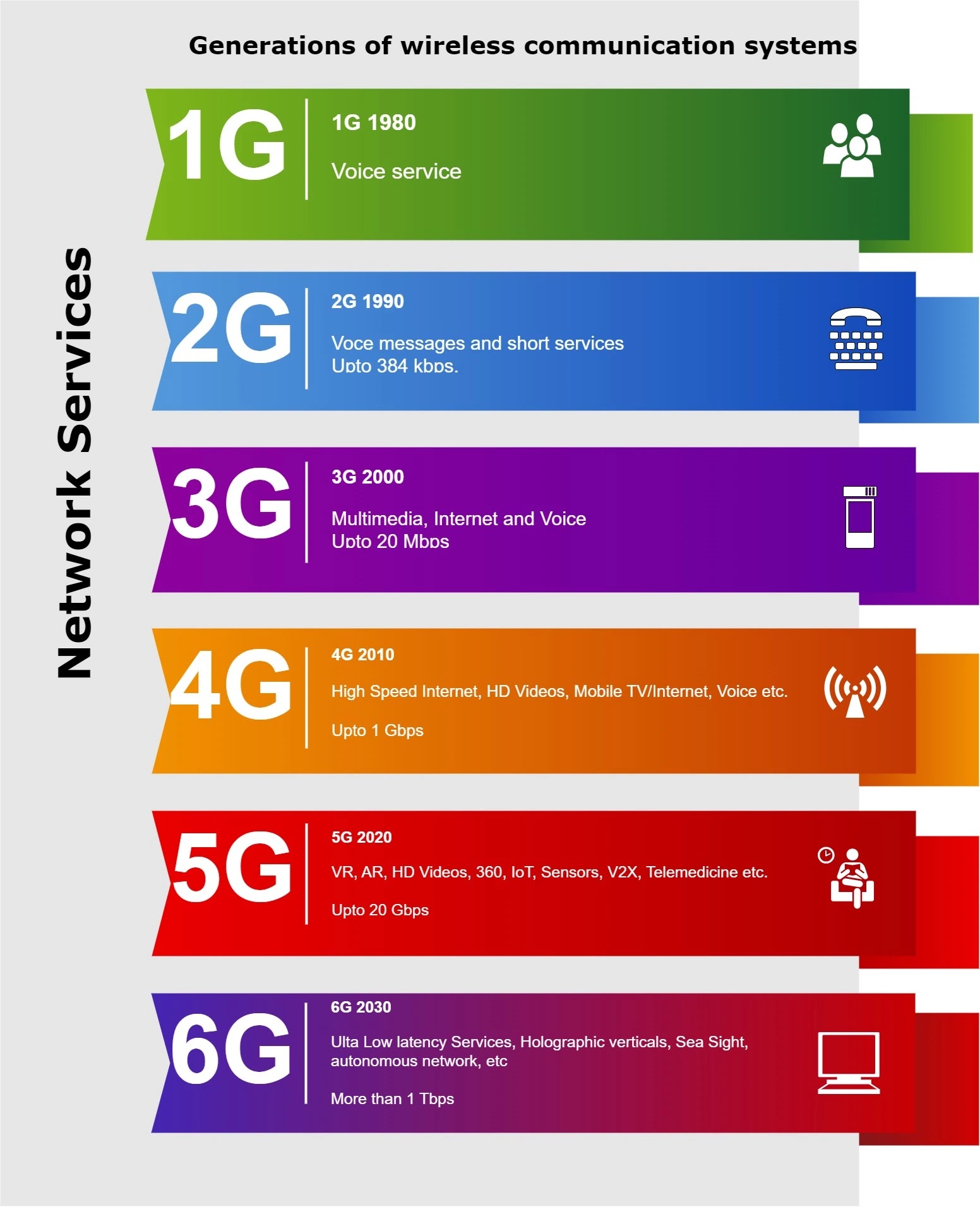
1. The Evolution of Wireless Connectivity
First generation (1G):
Mobile networks were designed for voice services with data rates of up to 2.4 kbit/s. Analog signals used to transmit information, and there was no universal wireless standard.
Second generation (2G):
Was based on digital modulation techniques and offered data rates of 50 Kbit/s to 384 Kbit/s, supporting not only voice services but also data services such as Short Message Service (SMS). The flagship 2G standard was the Global System for Mobile (GSM) communications.
Third generation (3G):
Mobile networks provided data rates of at least 2 Mbit/s and enabled advanced services including web browsing, TV streaming, and video services with data rates of up to 20 Mbit/s. To achieve global roaming, 3GPP was established to define technical specifications and mobile standards.
Fourth generation (4G):
Mobile networks were introduced in the late 2010s. 4G is an entirely Internet Protocol (IP) based network capable of providing high speed data rates of up to 1 Gbit/s in downlink and up to 500 Mbit/s in uplink to support advanced applications such as digital video broadcasting. DVB), high-definition TV content and video chat. LTE-Advanced (LTE-A) has been the dominant 4G standard, integrating technologies such as coordinated multipoint (CoMP) transmission and reception, multiple-input multiple-output (MIMO), and orthogonal frequency division multiplexing (OFDM).
Fifth generation (5G):
Is to use not only the microwave band but also the millimeter-wave (mmWave) band for the first time to significantly increase data rates to 20 Gbit/s. Another feature of 5G is the more efficient use of spectrum, as measured by increasing the number of bits per Hz. ITU's International Mobile Telecommunications 2020 (IMT 2020) standard proposed the following three major 5G usage scenarios:
1. Enhanced Mobile Broadband (eMBB),
1. Enhanced Mobile Broadband (eMBB),
2. Ultra-Reliable and Low Latency Communications (URLLC),
3. Massive Machine Type Communications (mMTC).
As 5G is entering the commercial deployment phase, research has begun to focus on 6G mobile networks, which are estimated to be deployed by 2030 Typically, next-generation systems do not emerge out of a vacuum, but rather follow industrial and technological trends from previous generations. Potential research directions for 6G in line with these trends were provided by Bi (2019), which included, among others:
2. What is 6G?
6G, short for the sixth generation of wireless technology, is envisioned to provide even faster data speeds, lower latency, greater capacity, and support for advanced technologies such as artificial intelligence, virtual reality, augmented reality, and the Internet of Things (IoT). It may also include innovations such as terahertz frequency bands, massive MIMO (multiple-input multiple-output) systems, and advanced antenna techniques to enhance network performance.
● 6G will continue to move to higher frequencies with wider system bandwidth: given that the spectrum at lower frequencies is nearly exhausted, the current trend is to increase the data rate by more than 10 times for each generation to achieve wider bandwidth at higher frequencies Is:
● Massive MIMO will remain a key technology for 6G: Massive MIMO has been the defining technology for 5G which has enabled the antenna count to increase from 2 to 64. Given that performance gains have saturated in the areas of the channel coder and modulator, spectral efficiency increases for 6G in the multiple antenna area will continue to be expected. MIMO Interview Questions Answers.
● 6G will continue to move to higher frequencies with wider system bandwidth: given that the spectrum at lower frequencies is nearly exhausted, the current trend is to increase the data rate by more than 10 times for each generation to achieve wider bandwidth at higher frequencies Is:
● Massive MIMO will remain a key technology for 6G: Massive MIMO has been the defining technology for 5G which has enabled the antenna count to increase from 2 to 64. Given that performance gains have saturated in the areas of the channel coder and modulator, spectral efficiency increases for 6G in the multiple antenna area will continue to be expected. MIMO Interview Questions Answers.
● 6G will take cloud service to the next level: With consistently higher data rates, lower latency, and lower transmission costs, many computational and storage functions have been moved from smartphones to the cloud. As a result, most of a smartphone's computational power can be focused on presentation rendering, making VR, AR or XR more efficient and affordable. Many Artificial Intelligence (AI) services that are intrinsically cloud based can be more easily and widely proliferated. In addition to smartphones, low-cost functional terminals may once again flourish, providing opportunities for development in more application areas.
● Grant-free broadcasts may become more prominent in 6G: In previous cellular network generations, broadcasts were primarily based on grant-oriented designs with strong centralized system control. 6G will require more advanced grant-free protocols and approaches. It is possible that non-orthogonal multiple access (NOMA) technology may have another chance to prevail due to its low-latency performance, even if it fails to take off during the 5G time period.
● MMTC is more likely to take shape in the older generation before succeeding in the next generation: MMTC has been one of the major directions for next-generation system design since the growth of the people-to-people communication market. High hopes are pinned on 5G MMTC to deliver significant growth for the cellular industry. However, so far, this expectation has been mismatched with reality.
● Grant-free broadcasts may become more prominent in 6G: In previous cellular network generations, broadcasts were primarily based on grant-oriented designs with strong centralized system control. 6G will require more advanced grant-free protocols and approaches. It is possible that non-orthogonal multiple access (NOMA) technology may have another chance to prevail due to its low-latency performance, even if it fails to take off during the 5G time period.
● MMTC is more likely to take shape in the older generation before succeeding in the next generation: MMTC has been one of the major directions for next-generation system design since the growth of the people-to-people communication market. High hopes are pinned on 5G MMTC to deliver significant growth for the cellular industry. However, so far, this expectation has been mismatched with reality.
3. The Vision for 6G
The vision for 6G is nothing short of revolutionary. It promises data transfer rates that are several times faster than 5G, potentially reaching terabits per second. This massive increase in speed will enable real-time applications, augmented reality experiences, and seamless connectivity on a scale we've never seen before.
4. Key Features of 6G Technology
a. Terahertz Frequencies
One of the defining features of 6G is its utilization of terahertz frequencies. These extremely high-frequency bands will allow for more data to be transmitted at a faster rate, paving the way for lightning-fast downloads and ultra-responsive networks.
b. AI Integration
6G will integrate artificial intelligence (AI) in its infrastructure to optimize network management, enhance security protocols, and adapt to user behavior in real-time. AI-driven networks will be capable of self-optimization, ensuring a seamless and efficient user experience.
c. Holographic Communication
Imagine being able to communicate with a life-like hologram of a loved one from across the globe. 6G aims to make this a reality by enabling high-definition holographic communication, transcending physical boundaries and bringing people closer together.
d. Quantum Communication
6G is set to explore the potential of quantum communication, which offers unparalleled levels of security and privacy. By harnessing the principles of quantum mechanics, 6G networks can ensure that data transmission remains impervious to hacking or interception.
5. Impact on Industries and Society
a. Healthcare
In the field of healthcare, 6G's ultra-reliable and low-latency connectivity will enable remote surgeries, empowering surgeons to operate on patients located miles away. Additionally, real-time health monitoring and diagnostics will become more accessible, leading to improved patient care.
b. Transportation
Autonomous vehicles will greatly benefit from 6G's lightning-fast response times and real-time data exchange. This technology will revolutionize transportation by enhancing safety, reducing congestion, and enabling vehicles to communicate seamlessly with each other and the surrounding infrastructure.
c. Entertainment and Gaming
6G's high-speed data transfer will revolutionize the entertainment and gaming industries. Users can expect lag-free streaming, immersive virtual reality experiences, and online gaming at levels of realism never seen before.
d. Education
In the realm of education, 6G will pave the way for enhanced remote learning experiences. Interactive virtual classrooms, augmented reality textbooks, and collaborative learning platforms will become the norm, offering students from diverse backgrounds access to quality education.
6. Challenges and Considerations
Despite the promising future of 6G, several challenges need to be addressed before its widespread adoption. Some of these challenges include:
a. Infrastructure Development
To realize the full potential of 6G, a robust and extensive infrastructure must be put in place. This includes the deployment of base stations, antennas, and fiber-optic networks to support the increased data demands.
b. Spectrum Allocation
As 6G incorporates terahertz frequencies, careful spectrum allocation is essential. These high-frequency bands have limited range and can be affected by environmental factors, requiring strategic planning to ensure consistent coverage.
c. Security and Privacy Concerns
With increased connectivity and AI integration, security and privacy become critical concerns. 6G networks must implement robust encryption and authentication mechanisms to protect user data and thwart potential cyber threats.
7. The Road to 6G
While 6G technology is still in its infancy, researchers, technology companies, and governments worldwide are already investing heavily in its development. Collaborative efforts and innovation will pave the way for 6G's eventual commercialization and integration into our daily lives.
Want to Become expert in LTE and 5G go through with below Practice Questions Answers Links:

5G Enhanced Mobile Broadband

Enhanced mobile broadband (abbreviated as eMBB) is one of three primary use cases that the 3rd Generation Partnership Project (3GPP) telecommunications standards group initially defined for the new 5G New Radio (NR) standard.
3GPP extensively used the eMBB use case with Machine Type Communication (mMTC) and Ultra-Reliable Low-Latency Communications (URLLC) to determine what type of functionality 5G NR is needed.
As its name suggests, eMBB reflects the growth in mobile broadband use cases supported by the 4G Long Term Evolution (LTE) standard.
eMBB use cases
10:19 PM

3GPP extensively used the eMBB use case with Machine Type Communication (mMTC) and Ultra-Reliable Low-Latency Communications (URLLC) to determine what type of functionality 5G NR is needed.
As its name suggests, eMBB reflects the growth in mobile broadband use cases supported by the 4G Long Term Evolution (LTE) standard.
eMBB use cases
– including improved automobile infotainment.
– improved Wi-Fi services.
– mobile high-definition video streaming.
– 3D multi-player games.
– all enabled by 5G NR's faster data transmission speeds.
– lower latency.
– greater capacity and other performance improvements.
– High data rate and high traffic volume.
NR 5G RRC
 UE is in CM-CONNECTED
UE stores Access Stratum context
UE reads System Information
UE monitors the Paging by PDCCH DCI using the P-RNTI
UE monitors the PCCH for CN paging using the 5G-S-TMSI and RAN paging using the I-RNTI
UE applies DRX for paging
Mobility is based upon Cell Reselection
AMF maintains NG signalling connection with gNodeb
UPF maintains GTP-U tunnels with gNodeb
Radio Access Network is responsible for UE reachability
UE Performs RNA updates
gNodeb knows the UE location with a resolution of a RAN Notification Area (RNA)


UE reads System Information
UE monitors the Paging by PDCCH DCI using the P-RNTI
UE monitors the PCCH for CN paging using the 5G-S-TMSI
UE applies DRX for paging
Mobility is based upon Cell Reselection
Core Network knows UE location with resolution of Registration Area (one or more Tracking Areas)
UE performs Registration Area updates with Core Network
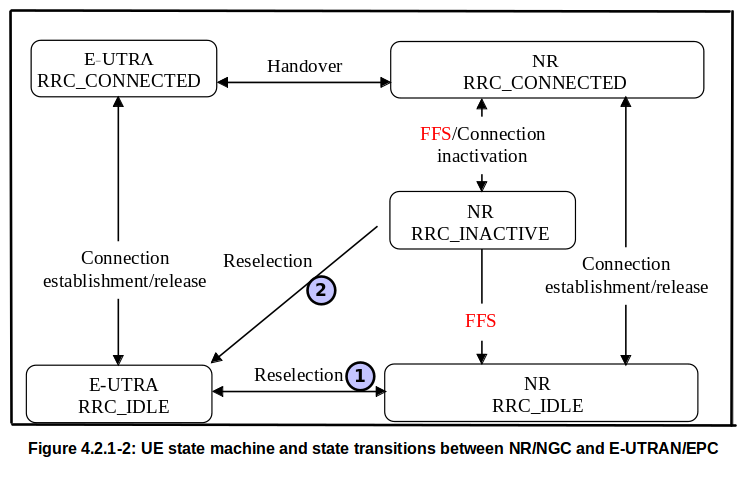
1. when UE in idle state it's NR RRC IDLE can reselect to EUTRA RRC IDLE and EUTRA RRC IDLE can reselct to NR RRC IDLE.
2. But, when UE is in NR RRC INACTIVE state, it can select to EUTRA RRC IDLE state, but EUTRA RRC IDLE state cannot reselect to NR RRC INACTIVE state.
5:17 PM
NR 5G RRC Overview
The Radio Resource Control (RRC) state machine for New Radio (NR) is shown in Fig. 4.2.1.1A UE starts from RRC Idle mode when it first camps on a 5G cell. for example. This can happen immediately after the device is switched on, or it can happen after inter-system cell reselection from LTE. A UE makes the transition from RRC idle to RRC Connected by completing the RRC setup process. An RRC connection is a logical connection between the UE and the base station.
In RRC connected mode a UE is assigned one or two C-RNTI (Cell Radio Network Temporary Identifiers). C-RNTI is used for addressing UEs when it require resource allocation from cell. A single C-RNTI is allocated when the UE is connected to a single base station. Two C-RNTIs are allocated when UE is connected using Multi-RAT Dual Connectivity (MR-DC)
In RRC connected mode a UE is configured with at least one Signaling Radio Bearer (SRB) and usually one or more Data Radio Bearers (DRB). SRBs can be used to transfer signaling messages between the UE and the base station. Signaling messages can be related to the RRC signaling protocol or the non-access striatum (NAS) signaling protocol. The base station uses the NG Application Protocol (NGAP) to transfer NAS messages to and from the AMF. The DRB can be used to transfer application data between the UE and the base station. Base station Uses a GTP-U tunnel to transfer data to and from the UPF.
UE has to change to RRC connected mode to register with the network, i.e. to change from RM-deregistered to RM-registered. Once a UE is registered with the network the UE will normally remain RM-registered, regardless of the RRC state. The registration process allots the UE with a temporary identity known as 5G-S-TMSI. Use of temporary identification instead of permanent identity, e.g. IMSI helps to improve security.
UE has to change to CM-IDLE to CM-connected, the UE must change to RRC connected mode. UE is returned to the CM-IDLE Whenever a RRC connection is released. The UE remains in CM-connected until change it state from RRC Connected to RRC idle.
A UE change from RRC Connected to RRC Inactive using the RRC Release procedure. The RRC release message includes a 'suspendConfig' parameter structure that indicates that the UE is being moved to RRC inactive instead of RRC idle. The NG signaling connection between the base station and the AMF is maintained while the UE RRC is inactive. In addition, GTP-U tunnels are maintained between the base station and UPF (one GTP-U tunnel per PDU session). UE context is also maintained by both the network and the UE
The RRC Idle state allows the UE to return to RRC Connected and begin transferring application data or signaling messages with minimal latency. For RRC-associated signaling load is reduced relative to inactive RRCs because the UE context is already established. The RRC idle state allows the UE to reduce the battery power consumption associated with the RRC. This can be achieved with longer DRX cycles and does not require channel quality reporting.
A UE change from RRC Connected to RRC Inactive using the RRC Release procedure. The RRC release message includes a 'suspendConfig' parameter structure that indicates that the UE is being moved to RRC inactive instead of RRC idle. The NG signaling connection between the base station and the AMF is maintained while the UE RRC is inactive. In addition, GTP-U tunnels are maintained between the base station and UPF (one GTP-U tunnel per PDU session). UE context is also maintained by both the network and the UE
The RRC Idle state allows the UE to return to RRC Connected and begin transferring application data or signaling messages with minimal latency. For RRC-associated signaling load is reduced relative to inactive RRCs because the UE context is already established. The RRC idle state allows the UE to reduce the battery power consumption associated with the RRC. This can be achieved with longer DRX cycles and does not require channel quality reporting.
The AMF can request the base station to provide notifications when the UE moves between RRC connected and RRC inactive. This request can be included in the ngap 'Initial context setup request' or 'UE context modification request' messages. The base station subsequently provides updates using the NGAP 'RRC inactive Transition Report'. The AMF can use this information to adjust its observation timer with respect to the RRC status of the UE. For example, if the AMF knows that the UE is connected to the RRC it can expect a rapid response to any downlink transaction and therefore it can implement a relatively short supervision timer. If the AMF knows that the UE RRC is inactive it can expect a less rapid response to any downlink transactions as those transactions must be paginated in the UE before forwarding to the UE. The amf can thus apply a long observation timer to the UE that is RRC inactive.
Switching between NR RRC CONNECTED <-> INACTIVE <-> IDLE State Change
 UE is in CM-CONNECTED state
UE stores Access Stratum context
UE reads System Information
UE monitors the Paging by PDCCH DCI using the P-RNTI
UE is addressed using C-RNTI allocated by gNodeb
Connected Mode DRX can be configured
Mobility is based upon handovers
AMF maintains NG signalling connection with gNodeb
UPF maintains GTP-U tunnels with gNodeb
Radio Access Network is responsible for UE reachability
Uplink and downlink data can be transferred
UE reports Channel State Information (CSI)
UE monitors Control Channels for Resource Allocations
UEs supporting CA, use of one or more SCells, aggregated with the SpCell, for increased bandwidth
UEs supporting DC, use of one SCG, aggregated with the MCG, for increased bandwidth
RRC CONNECTED
UE stores Access Stratum context
UE reads System Information
UE monitors the Paging by PDCCH DCI using the P-RNTI
UE is addressed using C-RNTI allocated by gNodeb
Connected Mode DRX can be configured
Mobility is based upon handovers
AMF maintains NG signalling connection with gNodeb
UPF maintains GTP-U tunnels with gNodeb
Radio Access Network is responsible for UE reachability
Uplink and downlink data can be transferred
UE reports Channel State Information (CSI)
UE monitors Control Channels for Resource Allocations
UEs supporting CA, use of one or more SCells, aggregated with the SpCell, for increased bandwidth
UEs supporting DC, use of one SCG, aggregated with the MCG, for increased bandwidth
RRC INACTIVE
UE stores Access Stratum context
UE reads System Information
UE monitors the Paging by PDCCH DCI using the P-RNTI
UE monitors the PCCH for CN paging using the 5G-S-TMSI and RAN paging using the I-RNTI
UE applies DRX for paging
Mobility is based upon Cell Reselection
AMF maintains NG signalling connection with gNodeb
UPF maintains GTP-U tunnels with gNodeb
Radio Access Network is responsible for UE reachability
UE Performs RNA updates
gNodeb knows the UE location with a resolution of a RAN Notification Area (RNA)
<Table 1.>
<Table 2.>
<Table 3.>
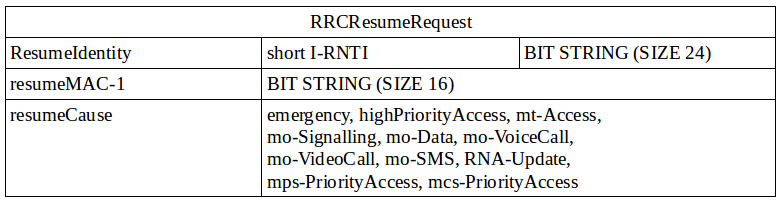
Signalling used to resume an RRC Connection at a Target eNodeb
Figure 112. shows the signaling call flow used to resume the RRC connection at a Target gNodeb. UE initiates the process by sending either RRC Resume Request or RRC Resume Request 1. The contents of these messages are presented in Tables No. 2 or 3. The selection is based on the 'useFullResumeID' flag present in SIB1. Both messages contain I-RNTI, MAC-I and cause values. The MAC-I information element is used to authenticate the UE before the UE is re-enter to RRC Connected at source gNodeb.<Figure 112>
RRC IDLE
UE is in CM-IDLE stateUE reads System Information
UE monitors the Paging by PDCCH DCI using the P-RNTI
UE monitors the PCCH for CN paging using the 5G-S-TMSI
UE applies DRX for paging
Mobility is based upon Cell Reselection
Core Network knows UE location with resolution of Registration Area (one or more Tracking Areas)
UE performs Registration Area updates with Core Network
NR RRC Interaction with LTE RRC
NR RRC is involved not only in NR but also in other radio access technology. The interaction of NR RRC and LTE RRC can be represented as follows. Here are the things to note1. when UE in idle state it's NR RRC IDLE can reselect to EUTRA RRC IDLE and EUTRA RRC IDLE can reselct to NR RRC IDLE.
2. But, when UE is in NR RRC INACTIVE state, it can select to EUTRA RRC IDLE state, but EUTRA RRC IDLE state cannot reselect to NR RRC INACTIVE state.
5G QoS
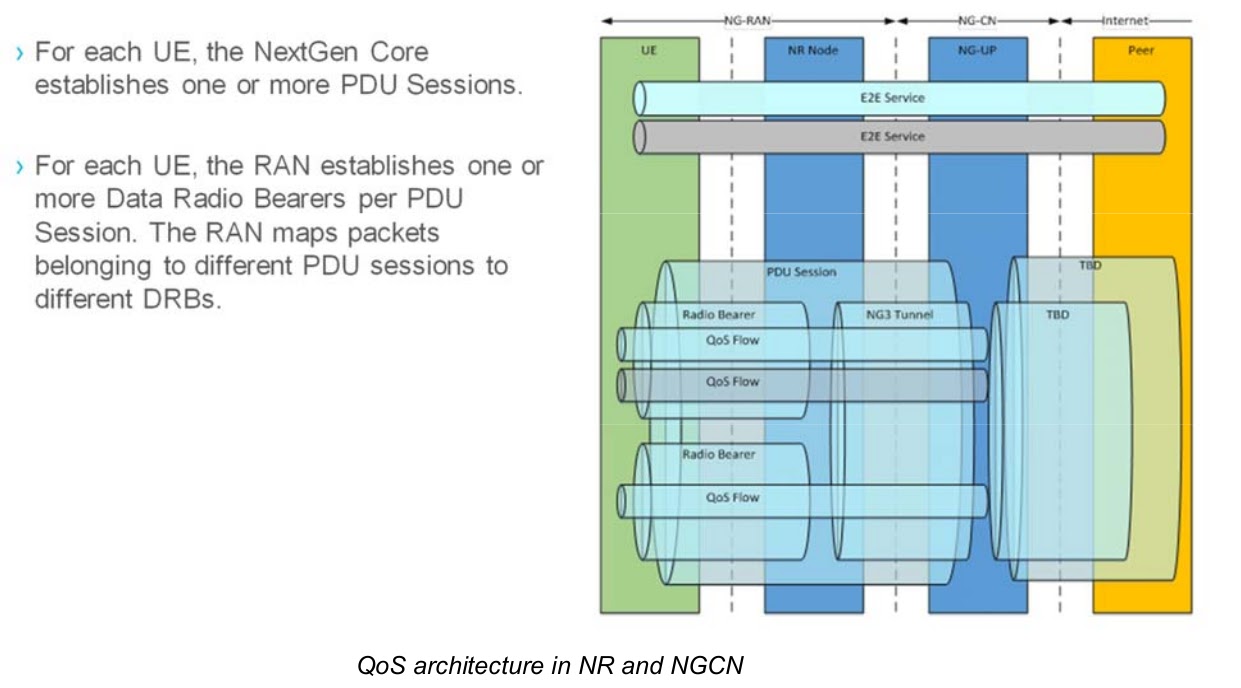

Note: Policing of user plane traffic (eg MFBR enforcement) is not considered QoS differentiation and is carried out by the UPF at SDF level granularity.
Each QoS flow (GBR and non-GBR) is associated with the following QoS parameters:
1) For non-GBR QoS flows with standardized 5QI, the standardized 5QI value is used as QFI and the default ARP is used. In this case no additional N2 signaling is required at the time of traffic when the corresponding QoS flow starts, or;
2) For GBR and non-GBR QoS flows, all the required QoS parameters related to QFI are sent as a QoS profile to the (R) AN in the PDU session establishment or QoS flow establishment / modification
The QoS parameters of a QoS flow are provided to the (R)AN as a QoS profile over N2 at PDU Session or at QoS flow establishment and when 5G-RAN is used at every time the User Plane is activated. QoS parameters can be pre-configured in (R) AN for non-GBR QoS flows (ie without the need to signal over N2).
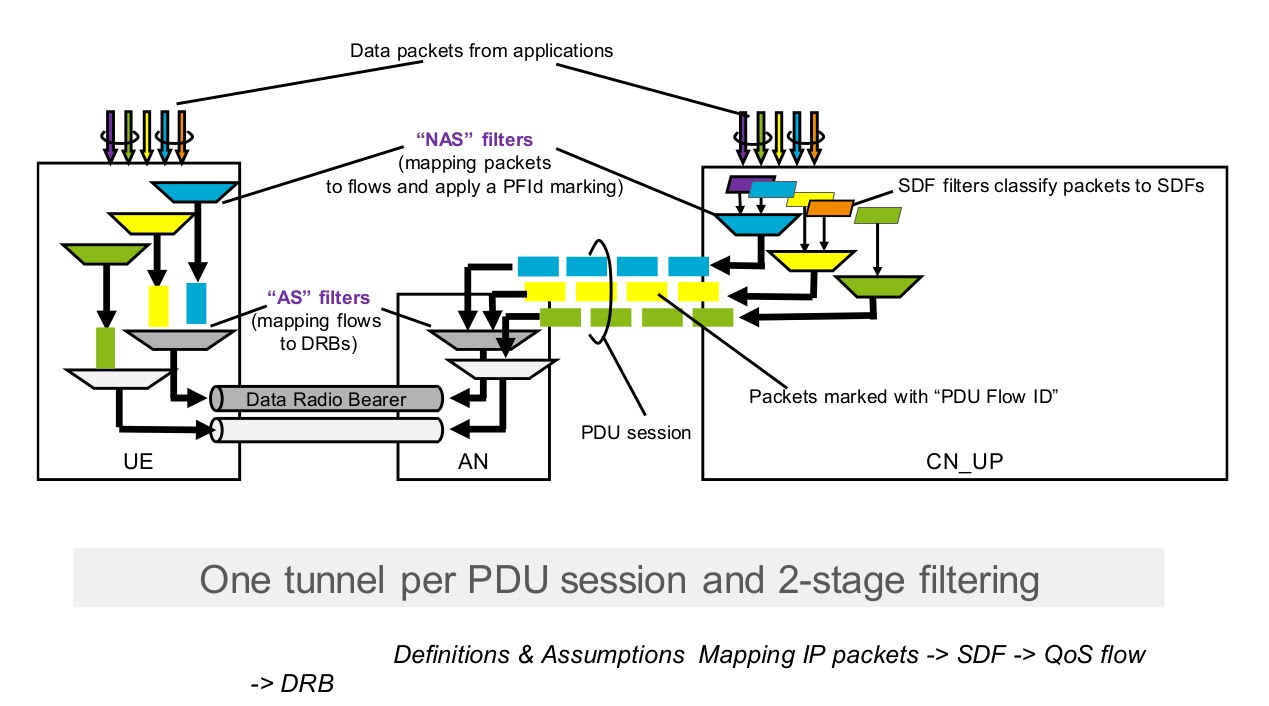
The UE classifies and marks the UL user plane traffic based on QoS rules, that is, the linking of uplink traffic to the QoS flow. These rules can be explicitly signalled over N1 (on PDU session establishment or QoS flow establishment), preconfigured in UE or implicitly derived by UE from reflective QoS. The QoS rule consists of a QoS rule identifier, the QFI of the QoS flow, and a QoS flow template (ie the set of packet filters and the associated precedence values associated with the QoS flow).
A default QoS rule is required for every PDU session. The default QoS rule shall be the only QoS rule of a PDU session which is allowed not to have a QoS flow template. If the default QoS rule does not contain a QoS flow template, the default QoS rule defines the treatment of packets that do not match a QoS flow template of a QoS rule in a PDU session.
The SMF allocates the QFI for each QoS flow and derives its QoS parameters from the information provided by the PCF. When applicable, the SMF provides the QFI with a QoS profile containing the QoS parameters of a QoS flow to the (R)AN. The SMF provides the SDF template (i.e. the set of packet filters associated with the SDF derived from the PCF) with the SDF preference and the corresponding QFI to the UPF enabling the classification and marking of user plane traffic. When applicable, SMF generates QoS rule (s) for QoS flows by allocating QoS rule identifiers, adding QFIs to QoS flows, and setting the QoS flow template using one or more SDF templates. QoS rules are then provided to the UE to enable classification and marking of UL user plane traffic.
For DL traffic AN can detect which flow a received packet belongs to by looking in the encapsulation tunnel header, where the UPF has marked the packet with the QoS Flow Indicator (QFI). Information about the treatment of each flow is sent from 5GCN to AN over N2.
UE for UL traffic marks traffic with the correct QFI based on the information received from the SMF over N1 interface. The solution will also be available for Reflective QoS where the UE marks the UL traffic based on which QFI is the DL traffic corresponding to the same flow. AN informs the UE how to send PDUs over the air (which radio bearer to use).
Each PDU session in a session establishment is associated with a default QoS profile (a set of QoS parameters).
SDF, which consists of the following, assigned QoS profile:
6:25 PM
Quality of Service (QoS) with 5GC Quality
A flow in this context is a QoS flow: all Packet Data Units (PDUs) that will receive the same QoS facility in the network, are used to classify PDUs into QoS flows. Filters can be provided with 5G policy control or can be pre-configured in 5G cores.QoS Model General Overview
The 5G QoS model supports the QoS flow-based framework. The 5G QoS model supports both QoS flows that require guaranteed flow bit rates and QoS flows that do not require guaranteed flow bit rates. The 5G QoS model also supports reflective QoS.

QoS flow is the best granularity of QoS resolution in a PDU session.
QoS flow is the best granularity of QoS resolution in a PDU session. QoS Flow ID (QFI) is used to identify QoS flows in a 5G system. User plane traffic with the same QFI within the PDU session receives the same traffic forwarding treatment (eg scheduling, admission threshold). The QFI is carried in an encapsulation header on N3 (and N9), ie without making any changes to the e2e packet header. It can be applied to various types of payloads, ie IP packets, non-IP PDUs, and PDUs with Ethernet frames. The QFI will be unique within the PDU session.
QoS flow is the best granularity of QoS resolution in a PDU session. QoS Flow ID (QFI) is used to identify QoS flows in a 5G system. User plane traffic with the same QFI within the PDU session receives the same traffic forwarding treatment (eg scheduling, admission threshold). The QFI is carried in an encapsulation header on N3 (and N9), ie without making any changes to the e2e packet header. It can be applied to various types of payloads, ie IP packets, non-IP PDUs, and PDUs with Ethernet frames. The QFI will be unique within the PDU session.
Note: Policing of user plane traffic (eg MFBR enforcement) is not considered QoS differentiation and is carried out by the UPF at SDF level granularity.
Each QoS flow (GBR and non-GBR) is associated with the following QoS parameters:
- 5G QoS Indicator (5QI),
- Allocation and Retention Priority (ARP).
- Guaranteed Flow Bit Rate (GFBR) - UL and DL;
- Maximum flow bit rate (MFBR) - UL and DL;
- Notification control.
1) For non-GBR QoS flows with standardized 5QI, the standardized 5QI value is used as QFI and the default ARP is used. In this case no additional N2 signaling is required at the time of traffic when the corresponding QoS flow starts, or;
2) For GBR and non-GBR QoS flows, all the required QoS parameters related to QFI are sent as a QoS profile to the (R) AN in the PDU session establishment or QoS flow establishment / modification
The QoS parameters of a QoS flow are provided to the (R)AN as a QoS profile over N2 at PDU Session or at QoS flow establishment and when 5G-RAN is used at every time the User Plane is activated. QoS parameters can be pre-configured in (R) AN for non-GBR QoS flows (ie without the need to signal over N2).
The UE classifies and marks the UL user plane traffic based on QoS rules, that is, the linking of uplink traffic to the QoS flow. These rules can be explicitly signalled over N1 (on PDU session establishment or QoS flow establishment), preconfigured in UE or implicitly derived by UE from reflective QoS. The QoS rule consists of a QoS rule identifier, the QFI of the QoS flow, and a QoS flow template (ie the set of packet filters and the associated precedence values associated with the QoS flow).
A default QoS rule is required for every PDU session. The default QoS rule shall be the only QoS rule of a PDU session which is allowed not to have a QoS flow template. If the default QoS rule does not contain a QoS flow template, the default QoS rule defines the treatment of packets that do not match a QoS flow template of a QoS rule in a PDU session.
The SMF allocates the QFI for each QoS flow and derives its QoS parameters from the information provided by the PCF. When applicable, the SMF provides the QFI with a QoS profile containing the QoS parameters of a QoS flow to the (R)AN. The SMF provides the SDF template (i.e. the set of packet filters associated with the SDF derived from the PCF) with the SDF preference and the corresponding QFI to the UPF enabling the classification and marking of user plane traffic. When applicable, SMF generates QoS rule (s) for QoS flows by allocating QoS rule identifiers, adding QFIs to QoS flows, and setting the QoS flow template using one or more SDF templates. QoS rules are then provided to the UE to enable classification and marking of UL user plane traffic.
For DL traffic AN can detect which flow a received packet belongs to by looking in the encapsulation tunnel header, where the UPF has marked the packet with the QoS Flow Indicator (QFI). Information about the treatment of each flow is sent from 5GCN to AN over N2.
UE for UL traffic marks traffic with the correct QFI based on the information received from the SMF over N1 interface. The solution will also be available for Reflective QoS where the UE marks the UL traffic based on which QFI is the DL traffic corresponding to the same flow. AN informs the UE how to send PDUs over the air (which radio bearer to use).
Each PDU session in a session establishment is associated with a default QoS profile (a set of QoS parameters).
- The default QoS profile is usually configured in UDM and can be authorized by PCF
- The QoS profile indicates the treatment of all PDUs transferred within the PDU session and for which the network has not indicated PDU specific treatment.
- The PCF can modify the default QoS profile for a PDU session at any time during the session
QoS parameters per QoS flow:
- 5G QoS indicator (5QI)
- Allocation and Retention Priority (ARP)
- Maximum Flow Bit Rate
- Guaranteed Flow Bit Rate
- Notification control. Controls whether notification should be made if the QoS targets are no longer fulfilled for a QoS flow
QoS parameters per PDU session
- Aggregated session maximum bitrate (UL and DL) for all QoS flows of a PDU session that do not require a guaranteed flow bit rate.
- Aggregated UE maximum bitrate (UL and DL) for all QoS flows and sessions of the UE that do not require a guaranteed flow bit rate.

- Multiplexing flow within a PDU (PDN) session tunnel
- Flow identities indicates on the QoS profile
- The DRB is mapped to the PDU session tunnel
- Multiple DRBs possible per PDU session tunnel
- The PDCP header on UL carries the Flow Id to map to DSCP on UL
- Each packet have the DL Flow ID

 Services are mapped to the Service Data Flow (SDF)
SDF, which consists of the following, assigned QoS profile:
- SDF priority
- Maximum bitrate per SDF:
- Bitrate required per SDF
- Delivery characteristic per SDF
- Network behavior per service data flow

QoS flow, which contains the following parameters, a QoS profile is assigned:
- QoS flow priority
- Maximum bitrate per QoS flow
- Bitrate required per QoS flow
- Delivery characteristic per QoS flow
- Network behavior per QoS flow
The SDF of the same IP-CAN session can be considered as the SDF Aggregate
- All SDFs should have the same QCI / ARP
- GBR / MBR is summarized in GBF SDFs when multiplexing GBR SDFs
SDF Aggregates are mapped to UL/DL Packet Filters/EPS Bearers
- 1:1 relation – an SDF Aggregate uniquely defines the EPS Bearer
- Bearer QoS profile (QCI, ARP, GBR, MBR), per-UE parameter AMBR and subscription parameter RFSP signaled over S1
QoS Flow Id is mapped to Radio Bearers
- N: 1 relation
Based on pre-configured nodes, via OSS-RC
- Standardized QCI Characteristics
- Resource Type
- GBR / Non-GBR
- Packet Delay Budget (PDB)
- Packet Loss Rate (PLR)
- Priority
- Priority between bearers when target PDB cannot be met (by bearers
- competing for the same resource)
- Other parameters set in OSS, by operator in MOM
Ericsson Interview Question Answer, L&T Interview Questions Answers, Marquis Interview Questions Answers
 Q01. How you do log analysis on your day-to-day activity?
Q02. How do you configure ue for testing?
Q03. What type of bugs have you find out?
Q04. While doing an analysis of a bug report what analysis you sent to the development team?
Q05. What kind of analysis you have done for ex: rach, attach, and re-configuration failure what kind of analysis you’re doing?
Q06. What is ca and its functionality in ue conformance testing?
Q07. On which message a ue send capability report to the network?
Q08. What are the information elements present in the ue capability report?
Q09. Do you have any idea about srvcc and csfb?
Q10. What are the conditions of re-establishment?
Q11. What is the rrc re-establishment time?
Q12. If you send the wrong configuration, how will you know it’s a network issue or something?
Q13. How do you find network issues?
Q14. What is network forwarding?
Q15. Define lab setup?
Q16. How would you report bugs to the development team?
Q17. Define handover redirection?
Q18. Why handover is required?
Q19. What is the IRAT event?
Q20. Define c.a?
Q21. What is the release version you currently worked on?
Q22. Why do you want to join?
Q23. What are the lte events?
Q24. On which system simulator are you currently working?
Q25. What do you do on anite-9000?
Q26. What is your role in your company?
Q27. Do you have any questions for me?
11:07 AM

Q02. How do you configure ue for testing?
Q03. What type of bugs have you find out?
Q04. While doing an analysis of a bug report what analysis you sent to the development team?
Q05. What kind of analysis you have done for ex: rach, attach, and re-configuration failure what kind of analysis you’re doing?
Q06. What is ca and its functionality in ue conformance testing?
Q07. On which message a ue send capability report to the network?
Q08. What are the information elements present in the ue capability report?
Q09. Do you have any idea about srvcc and csfb?
Q10. What are the conditions of re-establishment?
Q11. What is the rrc re-establishment time?
Q12. If you send the wrong configuration, how will you know it’s a network issue or something?
Q13. How do you find network issues?
Q14. What is network forwarding?
Q15. Define lab setup?
Q16. How would you report bugs to the development team?
Q17. Define handover redirection?
Q18. Why handover is required?
Q19. What is the IRAT event?
Q20. Define c.a?
Q21. What is the release version you currently worked on?
Q22. Why do you want to join?
Q23. What are the lte events?
Q24. On which system simulator are you currently working?
Q25. What do you do on anite-9000?
Q26. What is your role in your company?
Q27. Do you have any questions for me?
Ericsson Interview Question Answer, HSC Interview Question Answer, Sasken Interview Question Answer, Trumind Interview Question Answer
 Q1. How a ue can search (provide) plmn list at that area where network is not available?
Q2. Is all plmn list should be visible for all the UE’s present in a network?
Q3. If physical layer provide all the plmn list in a geographical area then what NAS layer will do?
Q4. If i purchase a sim card from delhi and i switch on my device into mumbai than what will be happen?
Q5. How many PLMN id’s in a list?
Q6. When you power on your UE and physical layer search all plmn and create a list, then how our sim verify that this is my PLMN?
Q7. Your physical layer have own plmn list then why need to provide (plmn list) to higher layer?
Q8. What information UE get from PSS and apart from that?
Q9. How UE get the TS0 - - - TS19 of ofdm boundary there are 6 OFDM symbol and 7 OFDM symbol in a slot?
Q10. What is the importance of MIB?
Q11. We have 1024 SFN means 210 = 10bit SFN, but in MIB SFN is 8bit what is the reason?
Q12. In physical layer how many bits are align to MIB?
Q13. What kind of Information UE got into the RAR?
Q14. What is the purpose to Timing Advanced?
Q15. How enodeb calculate Timing Advanced?
Q16. What is Contention Resolution?
Q17. How network know that which preamble is using by which ue? How network differentite?
Q18. What are the Attach Req ie’s?
Q19. How many types of codec are there in LTE?
Q20. Codec name of VOLTE and CS Domain?
Q21. Handover happen before measurement gap or after measurement gap?
Q22. What do you understande by MAC CE?
Q23. Network send some update information to UE regarding update system information, so how ue know about update in SIB?
Q24. Suppose if i have 2 device 1st is DUT and 2nd is Reference device and my both device are far 200m from enodeb then is my DUT get only 1 mbps DL speed and Reference device get 40 mbps DL speed what is wrong in my DUT?
Q25. During handover performing what kind of Scheduling is happen? SPS or Dynamic?
1:54 PM
Q2. Is all plmn list should be visible for all the UE’s present in a network?
Q3. If physical layer provide all the plmn list in a geographical area then what NAS layer will do?
Q4. If i purchase a sim card from delhi and i switch on my device into mumbai than what will be happen?
Q5. How many PLMN id’s in a list?
Q6. When you power on your UE and physical layer search all plmn and create a list, then how our sim verify that this is my PLMN?
Q7. Your physical layer have own plmn list then why need to provide (plmn list) to higher layer?
Q8. What information UE get from PSS and apart from that?
Q9. How UE get the TS0 - - - TS19 of ofdm boundary there are 6 OFDM symbol and 7 OFDM symbol in a slot?
Q10. What is the importance of MIB?
Q11. We have 1024 SFN means 210 = 10bit SFN, but in MIB SFN is 8bit what is the reason?
Q12. In physical layer how many bits are align to MIB?
Q13. What kind of Information UE got into the RAR?
Q14. What is the purpose to Timing Advanced?
Q15. How enodeb calculate Timing Advanced?
Q16. What is Contention Resolution?
Q17. How network know that which preamble is using by which ue? How network differentite?
Q18. What are the Attach Req ie’s?
Q19. How many types of codec are there in LTE?
Q20. Codec name of VOLTE and CS Domain?
Q21. Handover happen before measurement gap or after measurement gap?
Q22. What do you understande by MAC CE?
Q23. Network send some update information to UE regarding update system information, so how ue know about update in SIB?
Q24. Suppose if i have 2 device 1st is DUT and 2nd is Reference device and my both device are far 200m from enodeb then is my DUT get only 1 mbps DL speed and Reference device get 40 mbps DL speed what is wrong in my DUT?
Q25. During handover performing what kind of Scheduling is happen? SPS or Dynamic?
Altron Interview Question Answer, Anritsu Interview Question Answer, Ericsson Interview Question Answer, L&T Interview Questions Answers, Qualcomm Interview Questions Answers
 Q1. Define resource allocation types in LTE?
Q2. Why SFN mod==4 use for MIB?
Q3. What is HARQ?
Q4. What is Scheduling Request (SR)?
Q5. Define BSR?
Q6. What do you understand by MIB and SIB?
Q7. Why PHICH comes in MIB?
Q8. What is difference between RRCConnectionReconfiguration and RRCre-establishment?
Q9. What is Measurement gap, and measurement object and what kind of information they will carry?
Q10. Which DCI format use for RAR?
Q11. Define Handover procedure?
Q12. Define DRX information before power on?
Q13. Define Cell Camping?
Q14. Define LTE Events?
Q15. How ue choose 1 Frequency out of many Frequencies broadcast by network?
Q16. How many PHICH group in System Bandwidth?
Q17. Why HARQ use 8 arm process?
Q18. Define Attach Failure Causes?
Q19. What is Fading? Type of Fading?
Q20. How would you calculate PathLoss?
Q21. Define Physical Layer data processing steps?
Q22. What is PUCCH and UCI or it’s Formats?
Q23. Define Transmission Mode? How many Transmission modes are present in LTE?
Q24. What is sidelink? Define Sidelink mapping?
Q25. How much experience do you have in TDD? Define TDD frame structure?
Q26. What is DCI? How many DCI formats are present in LTE?
Q27. What is Type0, Type1, and Type2 resource allocation in DCI?
Q28. What is the latest Bug you have found?
Q29. How would you report a Bug to developers? What is Bug Reporting format?
Q30. What is DTCH message name?
Q31. RRC send which message to NAS to get PLMN list?
Q32. Which layer activate CA?
6:38 PM
Q2. Why SFN mod==4 use for MIB?
Q3. What is HARQ?
Q4. What is Scheduling Request (SR)?
Q5. Define BSR?
Q6. What do you understand by MIB and SIB?
Q7. Why PHICH comes in MIB?
Q8. What is difference between RRCConnectionReconfiguration and RRCre-establishment?
Q9. What is Measurement gap, and measurement object and what kind of information they will carry?
Q10. Which DCI format use for RAR?
Q11. Define Handover procedure?
Q12. Define DRX information before power on?
Q13. Define Cell Camping?
Q14. Define LTE Events?
Q15. How ue choose 1 Frequency out of many Frequencies broadcast by network?
Q16. How many PHICH group in System Bandwidth?
Q17. Why HARQ use 8 arm process?
Q18. Define Attach Failure Causes?
Q19. What is Fading? Type of Fading?
Q20. How would you calculate PathLoss?
Q21. Define Physical Layer data processing steps?
Q22. What is PUCCH and UCI or it’s Formats?
Q23. Define Transmission Mode? How many Transmission modes are present in LTE?
Q24. What is sidelink? Define Sidelink mapping?
Q25. How much experience do you have in TDD? Define TDD frame structure?
Q26. What is DCI? How many DCI formats are present in LTE?
Q27. What is Type0, Type1, and Type2 resource allocation in DCI?
Q28. What is the latest Bug you have found?
Q29. How would you report a Bug to developers? What is Bug Reporting format?
Q30. What is DTCH message name?
Q31. RRC send which message to NAS to get PLMN list?
Q32. Which layer activate CA?
L&T Interview Questions Answers, Qualcomm Interview Questions Answers, Sasken Interview Question Answer, Trumind Interview Question Answer
 Q01. HOW YOU CONFIGURE UE FOR TESTING?Q02. WHAT TYPE OF BUGS YOU HAVE FIND OUT?
Q03. WHAT IS THE CONDITIONS OF RE-ESTABLISHMENT?
Q04. WHAT IS THE RRC RE-ESTABLISHMENT TIME?
Q05. IF YOU SEND A WRONG CONFIGURATION THAN HOW WILL YOU KNOW IT’S A NETWORK ISSUE OR SOMETHING?
Q06. HOW DO YOU FIND NETWORK ISSUE?
Q07. WHAT IS NETWORK FORWARDING?
Q08. DEFINE LAB SETUP?
Q09. HOW WOULD YOU REPORT BUG TO THE DEVELOPMENT TEAM?
Q10. DEFINE HANDOVER REDIRECTION?
Q11. WHY HANDOVER REQUIRED?
Q12. WHAT IS THE I-RAT EVENT?
Q13. DEFINE C.A?
Q14. WHAT IS THE RELEASE VERSION YOU CURRENTLY WORKED ON?
Q15. WHY YOU WANT TO JOIN?
Q16. WHAT IS LTE EVENTS?
Q17. WHICH SYSTEM SIMULATOR YOU ARE CURRENTLY WORKING?
Q18. WHAT YOU DO ON ANITE-9000?
Q19. WHAT IS YOUR ROLE IN YOUR COMPANY?
Q20. DO YOU HAVE ANY QUESTION FOR ME?
Q21. X2AP, S1AP HANDOVER?
Q22. HOW RESOURCE BLOCK ALLOCATE TO UE
1:26 PM
Q03. WHAT IS THE CONDITIONS OF RE-ESTABLISHMENT?
Q04. WHAT IS THE RRC RE-ESTABLISHMENT TIME?
Q05. IF YOU SEND A WRONG CONFIGURATION THAN HOW WILL YOU KNOW IT’S A NETWORK ISSUE OR SOMETHING?
Q06. HOW DO YOU FIND NETWORK ISSUE?
Q07. WHAT IS NETWORK FORWARDING?
Q08. DEFINE LAB SETUP?
Q09. HOW WOULD YOU REPORT BUG TO THE DEVELOPMENT TEAM?
Q10. DEFINE HANDOVER REDIRECTION?
Q11. WHY HANDOVER REQUIRED?
Q12. WHAT IS THE I-RAT EVENT?
Q13. DEFINE C.A?
Q14. WHAT IS THE RELEASE VERSION YOU CURRENTLY WORKED ON?
Q15. WHY YOU WANT TO JOIN?
Q16. WHAT IS LTE EVENTS?
Q17. WHICH SYSTEM SIMULATOR YOU ARE CURRENTLY WORKING?
Q18. WHAT YOU DO ON ANITE-9000?
Q19. WHAT IS YOUR ROLE IN YOUR COMPANY?
Q20. DO YOU HAVE ANY QUESTION FOR ME?
Q21. X2AP, S1AP HANDOVER?
Q22. HOW RESOURCE BLOCK ALLOCATE TO UE
Altron Interview Question Answer, Anritsu Interview Question Answer, Ericsson Interview Question Answer, Sasken Interview Question Answer
 Q01. What is the difference between priority and severity in Test Case bug reporting?
Q02. In which conditions ue have 2 ip addresses is it possible a ue can have 2 different ip or 2 same ip?
Q03. Define lab setup?
Q04. AT command for PDCP configurations and power on UE?
Q05. Replace 2 no’s values with each without create a new variable in python?
Q06. Define Handovers in LTE?
Q07. What are Cell re-selection procedures?
Q08. Difference between SRVCC and CSFB?
Q09. What is SDP protocol?
Q10. What is a magic cookie in IMS via message?
Q11. What is Standalone and Non-Standalone network architecture in 5G?
Q12. What is DRX?
Q13. Define a bug you have found yesterday?
Q14. How to report bug and what kind of tool you are using for debugging?
Q15. UE connects 2 pdn how many it have default bearer and dedicated bearer?
Q16. How many coding schemes are present in lte and their name with functionalities?
Q17. What is orthogonal coding scheme?
Q18. If your browsing an internet then ue required a dedicated bearer or default is enough define with details it’s possible or not and why?
Q19. What are the conditions of re-establishment and re-configurations in lte?
Q20. How many cells you can configure in SS?
Q21. How you analysis the logs?
Q22. How you capture UE logs?
Q23. Define SMS call flow architecture?
Q24. What are Attach failure cause?
9:49 PM
Q02. In which conditions ue have 2 ip addresses is it possible a ue can have 2 different ip or 2 same ip?
Q03. Define lab setup?
Q04. AT command for PDCP configurations and power on UE?
Q05. Replace 2 no’s values with each without create a new variable in python?
Q06. Define Handovers in LTE?
Q07. What are Cell re-selection procedures?
Q08. Difference between SRVCC and CSFB?
Q09. What is SDP protocol?
Q10. What is a magic cookie in IMS via message?
Q11. What is Standalone and Non-Standalone network architecture in 5G?
Q12. What is DRX?
Q13. Define a bug you have found yesterday?
Q14. How to report bug and what kind of tool you are using for debugging?
Q15. UE connects 2 pdn how many it have default bearer and dedicated bearer?
Q16. How many coding schemes are present in lte and their name with functionalities?
Q17. What is orthogonal coding scheme?
Q18. If your browsing an internet then ue required a dedicated bearer or default is enough define with details it’s possible or not and why?
Q19. What are the conditions of re-establishment and re-configurations in lte?
Q20. How many cells you can configure in SS?
Q21. How you analysis the logs?
Q22. How you capture UE logs?
Q23. Define SMS call flow architecture?
Q24. What are Attach failure cause?
Anritsu Interview Question Answer, Ericsson Interview Question Answer, Samsung Interview Question Answer, Trumind Interview Question Answer
 Q1. In EPC which node you comfortable?
Q2. Initial attach architecture?
Q3. Where GUTI allocates?
Q4. How MME know to send initial attach request particular S-Gw (out of 5-6 S-Gw present)?
Q5. How enb know to send initial attach request to particular MME (out of 5-6 MME present)?
Q6. RRC connection sent which channel?
Q7. What's IE present in create session request?
Q8. Types of handover in LTE?
Q9. About PCRF and its interface?
Q10. SIB information SIB1 to SIB8?
Q11. When S5 and S8 interface use?
Q12. Soft Handover and Hard Handover?
Q13. If UE has 16 Bearer than how much E-RAB will be established for a UE?
Q14. How many Bearers would be establishing between Single UE to Single PDN?
Q15. Can we use 2 Application via using 1 dedicated bearer or we have to require 2 bearers separately?
3:10 PM
Q2. Initial attach architecture?
Q3. Where GUTI allocates?
Q4. How MME know to send initial attach request particular S-Gw (out of 5-6 S-Gw present)?
Q5. How enb know to send initial attach request to particular MME (out of 5-6 MME present)?
Q6. RRC connection sent which channel?
Q7. What's IE present in create session request?
Q8. Types of handover in LTE?
Q9. About PCRF and its interface?
Q10. SIB information SIB1 to SIB8?
Q11. When S5 and S8 interface use?
Q12. Soft Handover and Hard Handover?
Q13. If UE has 16 Bearer than how much E-RAB will be established for a UE?
Q14. How many Bearers would be establishing between Single UE to Single PDN?
Q15. Can we use 2 Application via using 1 dedicated bearer or we have to require 2 bearers separately?
Anritsu Interview Question Answer, Ericsson Interview Question Answer, Trumind Interview Question Answer
 Q01. While working on Epc which Bug you have find out & which node you have prefered?
Q02. What is Power on procedure?
Q03. What is Msg1 and Msg2?
Q04. Explain Attach procedure?
Q05. What are Authentication IE's?
Q06. What are Security message IE's?
Q07. SRVCC call flow?
Q08. What is the difference between 2G, 3G and 4G?
Q09. Difference between CSFB and SRVCC?
Q10. While you working on RRC which Bug you have find out?
Q11. RRC Request IE's?
Q12. Events?
Q13. What is Resource?
Q14. Factorial Program in python?
Q15. Handover Type?
Q16. If DRX is disable does ue receive paging message?
Q17. Cell selection criteria?
Q18. Daily activity?
Q19. What is Rach?
Q20. Rlc all modes?
Q21. CPT in rlc?
Q22. Calling mode?
Q23. HARQ?
Q24. RRC re-establishment IE's?
Q25. Difference between SRB and DRB?
Q26. A3 and A4 which condition it will perform handover?
Q27. Nas dedicated message?
Q28. SRV Mapping?
Q29. CSFB call flow MO and MT?
Q30. DCI?
Q31. X2AP Handover?
Q32. I-RAT Handover?
Q33. Carrier Aggregation?
Q34. Paging & DRX?
Q35. Uplink and Downlink Speed Calculation?
Q36. Radio Link Failure?
Q37. RRC re-configuration?
Q38. CQI?
Q39. SMS flow?
2:44 PM
Q02. What is Power on procedure?
Q03. What is Msg1 and Msg2?
Q04. Explain Attach procedure?
Q05. What are Authentication IE's?
Q06. What are Security message IE's?
Q07. SRVCC call flow?
Q08. What is the difference between 2G, 3G and 4G?
Q09. Difference between CSFB and SRVCC?
Q10. While you working on RRC which Bug you have find out?
Q11. RRC Request IE's?
Q12. Events?
Q13. What is Resource?
Q14. Factorial Program in python?
Q15. Handover Type?
Q16. If DRX is disable does ue receive paging message?
Q17. Cell selection criteria?
Q18. Daily activity?
Q19. What is Rach?
Q20. Rlc all modes?
Q21. CPT in rlc?
Q22. Calling mode?
Q23. HARQ?
Q24. RRC re-establishment IE's?
Q25. Difference between SRB and DRB?
Q26. A3 and A4 which condition it will perform handover?
Q27. Nas dedicated message?
Q28. SRV Mapping?
Q29. CSFB call flow MO and MT?
Q30. DCI?
Q31. X2AP Handover?
Q32. I-RAT Handover?
Q33. Carrier Aggregation?
Q34. Paging & DRX?
Q35. Uplink and Downlink Speed Calculation?
Q36. Radio Link Failure?
Q37. RRC re-configuration?
Q38. CQI?
Q39. SMS flow?
Altron Interview Question Answer, Anritsu Interview Question Answer, Ericsson Interview Question Answer, Samsung Interview Question Answer
 Q1. In what procedure you are comfortable.Q2. You knew end to end call flows? Other node also?
Q3. What is your idea on handover and tau?
Q4. Which is the fastest handover?
Q5. Is there any possibility to change the gateway in HO?
Q6. UE having 3 bearers so in that one bearer is failing in handover than in situation what you will calling that handover success or failure?
Q7. in which message ue receive ip address?
Q8. How many eps bearer ue can have Actually?
Q9. What is Data bearers?
Q10. What is the maximum limit of E-RAB bearer?
Q11. How the pdn is getting connected using what basis and which parameters?
Q12. So who will be starting the dedicated bearer?
Q13. What are the role of HSS in the network?
Q14. Did you mean dedicated bearer is also try to create?
Q15. How PDN is selected see in the network there can be 10 pdn so ue 1 can connect to pdn2, ue 2 connect to pdn5. That can be mix and match it can connect any pdn so by using what parameter pdn is selected?
Q16. Why we require 4G?
Q17. Difference between 3G and 4G with technical answer?
Q18. Describe the LTE Architecture in details?
Q19. See in network there can be many S-GW than which S-GW will be selected?
Q20. Using the DNS what is the possibility select S-GW, means what it will check from DNS?
Q21. Where is the role of DNS server, role in the select in the S-GW?
Q22. HSS and DNS are same one?
Q23. How the latency will reduced in 4g by using what?
Q24. 3G user can access 4g network?
Q25. 4G user can access 3g network?
Q26. How call facility supported in lte?
Q27. So initial ue message what are the nas message possible in initial ue message?
Q28. Piggybacked message in initial ue message what is that?
Q29. Similar to attach request is their any other message in initial ue (service req) (tau req)?
Q30. Attach req contents?
Q31. Attach type available?
Q32. Esm message container in attach request?
Q33. In initial request ue that is the first message than how guti allocation is possible?
Q34. Why guti is being used?
Q35. What is the possibility of guti and why its coming as a new identity in picture?
Q36. What is the main ie in initial ue message without it there is no used for this message?
Q37. How network will differentiate between home and roaming subscriber?
Q38. What is that plmn id?
Q39. After finding that this ue is a roaming subscriber than what network will do?
Q40. Do you have any TTCN3 experience also?
Q41. How you debug attach reject log so you have got a log and the log you can see fetch and the getting attach reject what are the scenario of attach reject?
Q42. Have you heard for T-3412? And why is this is?
Q43. Why ue has to send TAU with timer?
Q44. Is it happened in idle and connected both?
Q45. When paging will happened you are getting the DL data than what are the scenario of paging?
Q46. Whenever you received a call than paging will happen with respect to ue? Either ue in idle or connected?
Q47. Tell me something you known in TTCN3?
Q48. What are your experience in python and main use of python?
Q49. How you can say this is flexible?
Q50. Weather it is a low level or high and medium level language?
Q51. Can you tell something about memory in python?
Q52. Stack and heap memory difference?
Q53. So how it will used in programming memory?
Q54. Can you tell about data types in python?
Q55. Mutable or immutable?
Q56. Day to day scenario what we will use mutable or immutable?
Q57. In python can you assign any negative number?
Q58. What are the different phases of testing you are worked on?
Q59. Have you work on preparing a test case?
Q60. So can you tell me the life cycle of defect? What kind of activity you will do till close that bug?
Q61. Do you have any question for me?
12:07 PM
Q3. What is your idea on handover and tau?
Q4. Which is the fastest handover?
Q5. Is there any possibility to change the gateway in HO?
Q6. UE having 3 bearers so in that one bearer is failing in handover than in situation what you will calling that handover success or failure?
Q7. in which message ue receive ip address?
Q8. How many eps bearer ue can have Actually?
Q9. What is Data bearers?
Q10. What is the maximum limit of E-RAB bearer?
Q11. How the pdn is getting connected using what basis and which parameters?
Q12. So who will be starting the dedicated bearer?
Q13. What are the role of HSS in the network?
Q14. Did you mean dedicated bearer is also try to create?
Q15. How PDN is selected see in the network there can be 10 pdn so ue 1 can connect to pdn2, ue 2 connect to pdn5. That can be mix and match it can connect any pdn so by using what parameter pdn is selected?
Q16. Why we require 4G?
Q17. Difference between 3G and 4G with technical answer?
Q18. Describe the LTE Architecture in details?
Q19. See in network there can be many S-GW than which S-GW will be selected?
Q20. Using the DNS what is the possibility select S-GW, means what it will check from DNS?
Q21. Where is the role of DNS server, role in the select in the S-GW?
Q22. HSS and DNS are same one?
Q23. How the latency will reduced in 4g by using what?
Q24. 3G user can access 4g network?
Q25. 4G user can access 3g network?
Q26. How call facility supported in lte?
Q27. So initial ue message what are the nas message possible in initial ue message?
Q28. Piggybacked message in initial ue message what is that?
Q29. Similar to attach request is their any other message in initial ue (service req) (tau req)?
Q30. Attach req contents?
Q31. Attach type available?
Q32. Esm message container in attach request?
Q33. In initial request ue that is the first message than how guti allocation is possible?
Q34. Why guti is being used?
Q35. What is the possibility of guti and why its coming as a new identity in picture?
Q36. What is the main ie in initial ue message without it there is no used for this message?
Q37. How network will differentiate between home and roaming subscriber?
Q38. What is that plmn id?
Q39. After finding that this ue is a roaming subscriber than what network will do?
Q40. Do you have any TTCN3 experience also?
Q41. How you debug attach reject log so you have got a log and the log you can see fetch and the getting attach reject what are the scenario of attach reject?
Q42. Have you heard for T-3412? And why is this is?
Q43. Why ue has to send TAU with timer?
Q44. Is it happened in idle and connected both?
Q45. When paging will happened you are getting the DL data than what are the scenario of paging?
Q46. Whenever you received a call than paging will happen with respect to ue? Either ue in idle or connected?
Q47. Tell me something you known in TTCN3?
Q48. What are your experience in python and main use of python?
Q49. How you can say this is flexible?
Q50. Weather it is a low level or high and medium level language?
Q51. Can you tell something about memory in python?
Q52. Stack and heap memory difference?
Q53. So how it will used in programming memory?
Q54. Can you tell about data types in python?
Q55. Mutable or immutable?
Q56. Day to day scenario what we will use mutable or immutable?
Q57. In python can you assign any negative number?
Q58. What are the different phases of testing you are worked on?
Q59. Have you work on preparing a test case?
Q60. So can you tell me the life cycle of defect? What kind of activity you will do till close that bug?
Q61. Do you have any question for me?
Anritsu Interview Question Answer, Ericsson Interview Question Answer, Samsung Interview Question Answer
 Q1. How you work on TTCN3?
Q2. Tell us about handover procedure of X2?
Q3. What happen when target enb get down and serving enb send an handover request toward target enb?
Q4. IE used at the time of rrc reconfiguration initiate mobility of handover?
Q5. Soft handover and Hard handover?
Q6. What happens when after receiving the measurement report from ue serving enb want to established the connection but target enb suddenly down?
Q7. After getting the reconfiguration message on phy on ue than it passing through the MAC RLC PDCP layer till RRC so what they do?
Q8. How ue knows that this is a rrc reconfiguration message (crnti) ?
Q9. RLC modes and there difference?
Q10. Type of DCI and there used?
Q11. SR and BSR difference and who initiate it?
Q12. Type of BSR?
Q13. Type of mac ul and dl control element?
Q14. Difference between harq and arq?
Q15. Different type of harq?
Q16. How ue or enb know that what is the harq process number?
Q17. What is meant by logical channel id and group?
Q18. What is cqi and there range and who sent it?
Q19. Is each cqi values is directly connect to mcs? Or what is the scenario, range of mcs?
Q20. What is ca? Do you experience about log related in ca?
Q21. What is PHR?
Q22. What is timing advance and why it is used in mac dl ce?
Q23. Different type of SRBs and DRBs and when which SRB is used?
Q24. What message are sending on SRB0,1,2?
Q25. Rrc establishment message sent by ue on which srb?
Q26. Rrc reconfig message sent by network on which srb?
Q27. Tell me rach procedure?
Q28. How the preamble info will selecting by ue like which preamble we should use?
Q29. What mobility control info and each config dedicated in rrc reconfiguration ie?
10:17 PM
Q2. Tell us about handover procedure of X2?
Q3. What happen when target enb get down and serving enb send an handover request toward target enb?
Q4. IE used at the time of rrc reconfiguration initiate mobility of handover?
Q5. Soft handover and Hard handover?
Q6. What happens when after receiving the measurement report from ue serving enb want to established the connection but target enb suddenly down?
Q7. After getting the reconfiguration message on phy on ue than it passing through the MAC RLC PDCP layer till RRC so what they do?
Q8. How ue knows that this is a rrc reconfiguration message (crnti) ?
Q9. RLC modes and there difference?
Q10. Type of DCI and there used?
Q11. SR and BSR difference and who initiate it?
Q12. Type of BSR?
Q13. Type of mac ul and dl control element?
Q14. Difference between harq and arq?
Q15. Different type of harq?
Q16. How ue or enb know that what is the harq process number?
Q17. What is meant by logical channel id and group?
Q18. What is cqi and there range and who sent it?
Q19. Is each cqi values is directly connect to mcs? Or what is the scenario, range of mcs?
Q20. What is ca? Do you experience about log related in ca?
Q21. What is PHR?
Q22. What is timing advance and why it is used in mac dl ce?
Q23. Different type of SRBs and DRBs and when which SRB is used?
Q24. What message are sending on SRB0,1,2?
Q25. Rrc establishment message sent by ue on which srb?
Q26. Rrc reconfig message sent by network on which srb?
Q27. Tell me rach procedure?
Q28. How the preamble info will selecting by ue like which preamble we should use?
Q29. What mobility control info and each config dedicated in rrc reconfiguration ie?
Q30. After receiving rar from enb ue send message 3 than how ue get grant of ul?
Q31. At the time of receiving rrc connection setup how ue knows that its his rrc connection setup?
Q32. Where the ul resource grant for sending rrc connection setup complete?
Q33. If we received sib and rrc setup at same time than how ue recognize which time it decode rrc message and sib?
Q34. Which channel used for sending sr and bsr?
Q35. How much process used in fdd?
Q36. What is the message send on srb2?
Q37. What is criteria used to follow for crate srb2?
Q38. What is meant by authentication req used in attach procedure?
Q39. Did security is enabled before sending authentication req?
Q40. What is the first message on srb2 between ue and enb that ue send?
Q41. What is the requirement of security enabled 2 times in attach procedure?
Q42. When mme send security mode command and what is the info present in it?
Q43. So in the security mode command there is direct transfer of key to ue mme or something different procedure?
Q44. Failure cases of rrc reconfiguration?
Q45. After receiving rrc connection setup than ue need to send rrc connection setup complete message so need ul resource where that resource comes from?
Q46. After receiving rrc reconfiguration message from PHY to MAC and MAC to RLC than what is the first work that done by RLC and using what mode of operation?
Q47. Security in attach procedure come to deal by which layer?
Q48. Can you tell me what is pics and pixit in TTCN3?
Q49. What is use and how to use TTCN3 as for scripting?
Q50. What is used of python scripting?
Q51. Difference between set, list and tuple in python?
Q52. How to write dictionary program?
Q53. How to check the message if rrc reconfiguration message is miss than how you know that what is bug because you can’t even show the rrc message than how you find it?
Q54. What you used in python scripting if rrc configuration message bug found?
Q31. At the time of receiving rrc connection setup how ue knows that its his rrc connection setup?
Q32. Where the ul resource grant for sending rrc connection setup complete?
Q33. If we received sib and rrc setup at same time than how ue recognize which time it decode rrc message and sib?
Q34. Which channel used for sending sr and bsr?
Q35. How much process used in fdd?
Q36. What is the message send on srb2?
Q37. What is criteria used to follow for crate srb2?
Q38. What is meant by authentication req used in attach procedure?
Q39. Did security is enabled before sending authentication req?
Q40. What is the first message on srb2 between ue and enb that ue send?
Q41. What is the requirement of security enabled 2 times in attach procedure?
Q42. When mme send security mode command and what is the info present in it?
Q43. So in the security mode command there is direct transfer of key to ue mme or something different procedure?
Q44. Failure cases of rrc reconfiguration?
Q45. After receiving rrc connection setup than ue need to send rrc connection setup complete message so need ul resource where that resource comes from?
Q46. After receiving rrc reconfiguration message from PHY to MAC and MAC to RLC than what is the first work that done by RLC and using what mode of operation?
Q47. Security in attach procedure come to deal by which layer?
Q48. Can you tell me what is pics and pixit in TTCN3?
Q49. What is use and how to use TTCN3 as for scripting?
Q50. What is used of python scripting?
Q51. Difference between set, list and tuple in python?
Q52. How to write dictionary program?
Q53. How to check the message if rrc reconfiguration message is miss than how you know that what is bug because you can’t even show the rrc message than how you find it?
Q54. What you used in python scripting if rrc configuration message bug found?
MIMO Interview Question Answer
9:19 PM
 Q1. What is MIMO and what are the functionalities of MIMO?
- (MIMO) stands for Multiple Input Multiple Output.
- The functionalities of MIMO it have multiple antenna at the transmitter side and multiple antenna also have at the receiver side.
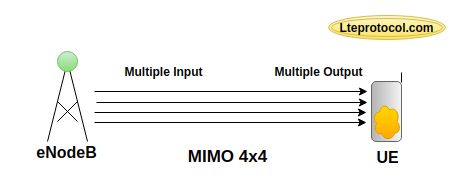
Q2. What is diversity and why it use in MIMO?
- Diversity is using to improve the reliability of the system.
- In diversity sender sends the data at different propagation (different paths).
- In MIMO we need the reliability or high speed data transmission so that we use two technique here 1. Spatial Diversity 2. Spatial Multiplexing.
Q3. What is Spatial Diversity?
- Spatial diversity is one of the fundamental benefits of MIMO technology.
- In short, diversity aims to improve the reliability of the system by sending same data over different propagation, or spatial, paths.
Q4. What is Spatial Multiplexing in MIMO?
- Spatial Multiplexing (SM, SMX) also known as Space Division Multiplexing (SDM) used to transmit data into independent channels separated by space.
- It’s like a pipeline through which data is flowing between the base station and the phone on a mobile network.
- Imagine a situation with one antenna on the base station and one on the phone that allows so much data to flow.
- Now, by installing more antennas on base station side with proper spatial separation, multiple virtual pipelines can be created in the space between phone and the base station.
- This creates multiple paths for more data to travel between the base station and mobile.
Q5. What are the advantages of MIMO?
- In MIMO UE experiencing good coverage (with high signal to noise ratios) can take advantage of the spatial multiplexing gain and can receive multiple parallel streams of data.

- Transmit and receive antenna have maximum number of parallel streams For example, 2x2 MIMO, 4x2 MIMO and 2x4 MIMO arc all capable of transferring a maximum of 2 parallel streams of data.
- UE in poor coverage (with a low signal to noise ratios) can take advantage of the diversity gain to help improve their signal to noise ratio.

- The magnitude of the diversity gain is dependent upon the number of receive antenna and the level of correlation between each of the propagation paths, i.e. the gain is maximised for a large number of receive antenna and uncorrelated propagation paths.
- This dependency upon channel conditions means that MIMO is used to transfer multiple parallel streams of data in good coverage conditions to maximise throughput, and is used to transfer a single stream of data in poor coverage conditions to maximise the diversity gain.
Q6. What are the disadvantages of MIMO?
- The drawbacks of MIMO are its increased implementation complexity and increased hardware requirement.
- MIMO requires additional processing at both the transmitter and receiver.
- It also requires additional signalling in terms of feedback from the receiver and resource allocation infonnation from the transmitter.
- MIMO requires additional power amplifiers at the transmitter side and additional receiving paths
- at the receiver side.
- lt also requires additional antenna elements at both the transmitter and receiver.
Q7. What is open loop? Why it use in MIMO?
- Open loop MIMO sender requires feedback from the receiver in terms of Rank Indication (RI) and Channel Quality Indicator (CQI).
- It’s called 'open loop' because of sender does not requiring feedback from transmitter in terms of a Precoding Matrix Indicator (PMI).
- Open loop MIMO can be beneficial for high mobility scenarios which would cause a reported PMI to become invalid after only a short period of time
Q8. What is Close Loop in MIMO?
- In Closed loop MIMO sender require feedback from the receiver in terms of RI, CQI and PMI.
- The receiver selects a PMI to help improve the properties of the composite channel coefficient matrix.
- Closed loop MIMO allows senders to transmits with increased informations.
- But it also increased the signalling overhead.
Q9. What is diversity gain in MIMO?
- Diversity gain reduces the impact of fading when the fades on each propagation path are uncorrelated, i.e. one path may experience a fade while another path may not experience a fade.
- The receiver takes advantage of the paths which are not experiencing fades.
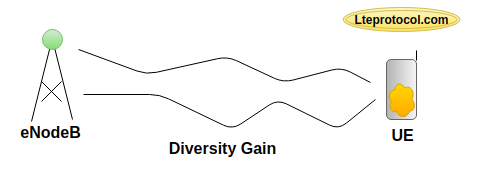
Q10. what is array gain in MIMO?
- Array gain is achieved from the beamforming effect which is generated when transmitting from multiple antenna elements.
- Beamforming directs the transmitted signal towards the UE and improves the received signal to noise ratio.

Q11. What is spatial multiplexing gain MIMO?
- Spatial multiplexing gain increases throughput by transferring multiple streams of data in parallel using the same set of time and frequency domain resources.
- Uncorrelated transmission paths allow the receiver to differentiate between the data streams.

Q12. According to 3GPP release 15 is mimo support in uplink direction if yes the what’s are combination support of mimo have?
- The 3GPP release 15 version of the specifications for New Radio (NR) supports MIMO in both the uplink and downlink directions.
- The uplink supports 2x2 MIMO and 4x4 MIMO, whereas the downlink supports 2x2 MIMO. 4x4 MIMO and 8x8 MIMO.
- The release 15 version of the specifications also supports Multi-User MfMO in both the uplink and downlink directions.
Q13. What is Single-User MIMO?
- Single User MIMO allocates a different subset of PRB to each UE, i.e. the UE are separated in the frequency domain.
- The UE which are scheduled during a specific time slot do not need to be spatially separated and a relatively high MCS can be allocated, because the transmissions to each UE do not interfere with each other.

Q14. What is Multi-User MIMO?
- Multi-User MIMO takes advantage of beamforming to allocate the same set of time and frequency domain resources to multiple UE.
- These UE are separated in the spatial domain so they are able to re-use Physical Resource Blocks (PRB) without generating significant levels of interference towards each other.

Q15. What are the advantage of MU-MIMO?
- Increased Network Capacity – Network Capacity is defined as the total data volume that can be served to a user and the maximum number of users that can be served with certain level of expected service.
- Improved Coverage – With massive MIMO, users enjoy a more uniform experience across the network, even at the cell’s edge, so users can expect high data rate service almost everywhere.
- User experience – Ultimately, the above two benefits result in a better overall user experience users can transfer large data files or download movies, or use data-hungry apps on the go,
Subscribe to:
Posts (Atom)