5G Interview Questions Answers, 5G Protocol Questions Answers
1:11 PM
Q01. What is 5G NR? Why it’s need if we have 4G?
12:46 AM

ANR (Automatic Neighbour Relation)
Actually before understand about ANR we
have to clear little bit concept on neighbour cell scenario. What happened is
every eNB attached the neighbour cell list inside SIBs. This is operator work
to configure these details in system Info So There are two ways that network
operator put this details inside the various cells.
1.
Manually configuration:
Its done manually by the Operator but
here are some issue with it:
a. First operator need to provide special
person to investigate it which is cost effective and also neighbour cells are
changes time to time by shifting cells on demand
2.
Automatic configuration
: This is technique the eNB are used for automatic configuration of neighbour cell
which is known as Automatic neighbour request. Its a easier way of
configuration. Procedure is as follows:
a. First N/W will send Measurement control
Req to UE for performing the measurement
of cell around its geographical area and provide list to N/W that has sent
Measurement control Req earlier.
b. N/W will decode the measurement report
and update the neighbouring list according to the received report from UE.
TAU(Tracking Area Update)
First the question is How UE get to know that TAC is changed? So our answer is this information is present in a SIB1.
Now second question is when TAU report has to send?
Actually we have something called TAI list which is already has provided by MME to UE at the time of registration. For more information Refer TAI.
Below
I have attached the flow of TAU
procedure:
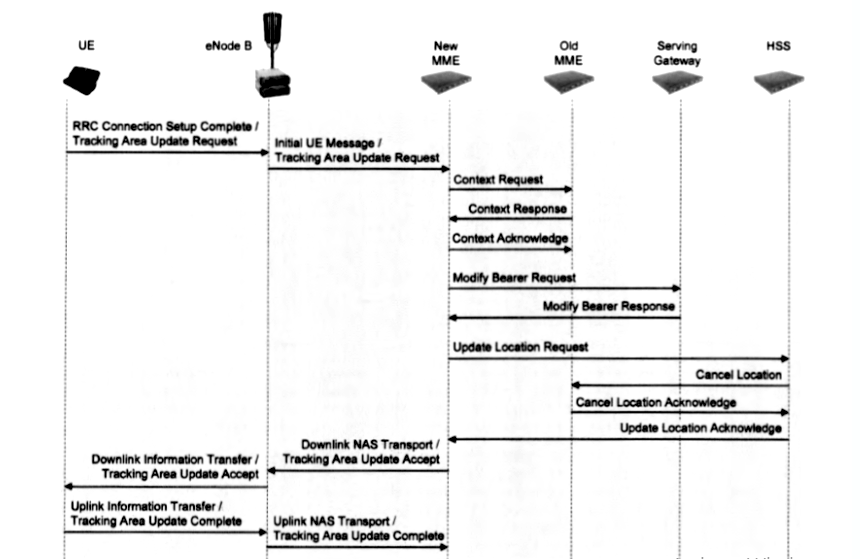
TAU Procedure flow Diagram
TAU trigger conditions:
1. Normal TAU is due to mobility i.e when UE enters in Tracking Area which is not included within the list of tracking areas with which the UE has registered.
2. Periodic TAU after T3412 timer Expires.
3. Reregistering the EPS after CSFB connection has been completed.
4. MME load balancing.
Note 1: It is triggered in both in IDLE and Connected mode, but Suppose
UE in connected mode and try to to move to new location, In this UE known to
the network and easily handed over to new cell but if UE found that its TAC isn’t
part of TAI list now than it will triggered TAU procedure to the MME.
Note 2: It doesn’t means UE always be in Connected mode but it can be
come again in IDLE mode.Than Suppose if N/W want to send some information to
the UE than in this case MME need to know the exact location of UE because
might be UE was is moving state in IDLE and doing its cell selection and reselection
than here also only extreme procedure which we have is TAU procedure. But as in
the above flow diagram we have seen that TAU is piggybacked on rrcconnectionsetupcomplete msg so its a connected mode msg so how this stuff
work. So The perfect answer is UE can begin the TAU procedure in IDLE mode but UE
must be in RRC Connected mode to actually complete the procedure.
5g PUCCH, 5G PUSCH

1:25 PM
5G PUCCH and 5G PUSCH
PUCCH is used to
carry Uplink Control Information (UCI), and following types of UCI are
supported in NR:
·
Hybrid automatic
repeat request acknowledgement (HARQ-ACK): information to report whether the DL
transmission of a TB is successful or not
·
Scheduling request
(SR): signal to request UL grant to gNB
·
Channel state
information (CSI): information represents channel condition between gNB and UE
The UCI can be
carried by PUCCH or PUSCH. The channel coding schemes for different UCI sizes
are shown in Table.
Channel coding for uplink control information (UCI)
UCI size including
CRC, if present
|
Channel code
|
1
|
Repetition code
|
2
|
Simplex code
|
3-11
|
Reed Muller code
|
>11
|
Polar code
|
- For HARQ-ACK feedback of PDSCH with corresponding DCI, PUCCH resource set(s) containing one or more PUCCH resources are configured.
- One PUCCH resource is determined based on the UCI payload size and the PUCCH resource indicator field in the DL assignment. For HARQ-ACK feedback of PDSCH without corresponding DCI, SR, and CSI report, a PUCCH resource is configured for each.
- When multiple PUCCHs are overlapped fully or partially in time, the UCIs are multiplexed in a PUCCH.
- When a PUCCH is overlapped with a PUSCH fully or partially in time, the UCI is multiplexed (i.e. piggybacked) on the PUSCH.
- Each PUCCH resource is configured with a PUCCH format. Various PUCCH formats are specified as in Figure.
- Each PUCCH format supports either durations of 1 to 2 symbols, or durations of 4 to 14 symbols.
- PUCCH formats 0/2 are called as short-PUCCH, which can deliver UCI by 1 or 2 symbols. PUCCH formats 0/2 are beneficial to reduce latency.
- PUCCH formats 1/3/4 are called as long-PUCCH, which can deliver UCI with any of 4 to 14 symbols. PUCCH formats 1/3/4 are adopted to improve coverage.
- The frequency/time-domain resources for PUCCH transmissions in NR are flexibly configurable.
- In PUCCH format 0/1/4, multiple PUCCH resources can be CDMed on the same time/frequency resource.
- A short-PUCCH can be TDMed with a long-PUCCH or a short PUCCH within a slot.

NR PUCCH formats
PUSCH is used to
transmit one TB. A DCI in a PDCCH can schedule a PUSCH transmission with DM-RS
(and other RS if any). The PUSCH is transmitted based on the information in the
PDCCH, for example, time/frequency-domain resource including frequency-hopping,
modulation, and layer. The number of layers for PDSCH transmissions is 4. HARQ
re-transmission is supported for PUSCH transmissions as mentioned in Section
5G PDCCH, 5G PDSCH
12:52 PM
5G PDCCH and 5G PDSCH
5G PDCCH is used
to carry Downlink Control Information (DCI), and following types of DCI are
supported in NR.
* PDSCH assignments to convey TB(s) to a certain
UE, including time/frequency-domain resource information
* PUSCH grants for a certain UE to transmit a
TB, including time/frequency-domain resource information
* Slot format indication, where how each of
symbols within a slot is indicated
* Pre-emption indication, which is used to
inform UEs that there is no DL transmission on the informed
time/frequency-domain resources
* UL transmit power control (TPC)
* Each device monitors a number of PDCCHs, typically once
per slot although it is possible to configure more frequent monitoring to
support traffic requiring very low latency. Upon detection of a valid PDCCH,
the device follows downlink control information contained in the PDCCH, e.g.,
the scheduling decision so that the device receives PDSCH (or transmits PUSCH)
accordingly.
* The PDCCHs are
transmitted in one or more control resource sets (CORESETs). A CORESET spans overdone,
two or three OFDM symbol(s) in time domain and over a configurable bandwidth in
the frequency domain. This is needed in order to handle devices with different
bandwidth capabilities and also beneficial from a forward-compatibility
perspective. One control channel element (CCE) is defined as 6 resource element
groups (REGs), where 1 REG is composed of 12 resource elements (REs). In a
CORESET, a PDCCH with DM-RS can be mapped on one or more CCEs as shown in
Figure. Different number of CCEs (aggregation level) provides different coding
rate for the control channels.
There are
different formats for DCI transmitted on a PDCCH as shown in DCI Table. A UE
monitors one or more PDCCH candidates for DCI with CRC scrambled by a certain
RNTI in PDCCH common search space (CSS) set and/or UE-specific search space
(USS) set. DCI format is distinguished by the PDCCH payload size and the RNTI
scrambling the CRC.

NR DCI formats
DCI format
|
RNTI
|
Notes
|
DCI format 0_0
|
RA-RNTI, TC-RNTI, C-RNTI, CS-RNTI
|
Monitored on CSS or USS
Scheduling PUSCH
|
DCI format 0_1
|
C-RNTI, CS-RNTI
|
Monitored in USS
Scheduling PUSCH
|
DCI format 1_0
|
SI-RNTI, RA-RNTI,
P-RNTI, C-RNTI, CS-RNTI
|
Monitored in CSS or USS
Scheduling PDSCH
|
DCI format 1_1
|
C-RNTI, CS-RNTI
|
Monitored in USS
Scheduling PDSCH
|
DCI format 2_0
|
SFI-RNTI
|
Monitored in CSS
Indicating slot format for slot(s)
|
DCI format 2_1
|
INT-RNTI
|
Monitored in CSS
Indicating pre-emption of DL resource
|
DCI format 2_2
|
TPC-PUSCH-RNTI, TPC-PUCCH-RNTI
|
Monitored in CSS
Group-TPC command for PUSCH/PUCCH
|
DCI format 2_3
|
TPC-SRS-RNTI
|
Monitored in CSS
Group-command for SRS
|
PDSCH is used to
transmit one or two transport blocks (TBs). A DCI in a PDCCH can assign a PDSCH
transmission with DM-RS (and other RS if any). The PDSCH is decoded based on
the information in the PDCCH, for example, time/frequency-domain resource, modulation,
and layer. PDSCH transmissions are processed with durations from 2 to 14
symbols. The number of layers for PDSCH transmissions is 8. HARQ feedback/retransmission
is supported for PDSCH transmissions as mentioned in HARQ Post.
5G Rach Procedure, LTE Rach Procedure

11:33 PM
RAP(Random Access
Procedure)
Random Access procedure is essential part of for LTE protocol communication and used for getting the grant of Uplink resources for sending RRC message first time so that UE will attached to Network. So Here I tried to provide you RAP step wise step.

RA Procedure Messages with Timers
1.
UE MAC(refer Ans 1) select a preamble out of the
available 64 preamble randomly(0-64) either contention based or Non contention
Based.
2.
UE MAC gives this preamble to UE physical
for dispatch.
3.
UE MAC tells UE physical about which PRACH resource(refer Ans 23) should be used for preamble sending.
4.
UE Phy transmit the preamble on the
selected PRACH resources.
5.
Before Transmission UE physical calculate RA-RNTI (refer Ans 36).
6.
eNB physical received preamble on PRACH
resource and calculate RA-RNTI first.
7.
eNB phy forward the preamble to eNB MAC.
8.
eNB MAC allocate UL resource for the UE and
this information forwarded to UE.
9.
eNB MAC prepares a message called
RAR(Random Access Response) with the following detail:
a.
Preamble ID
b.
PUSCH PRB
c.
T-C-RNTI
d.
Timing Advance

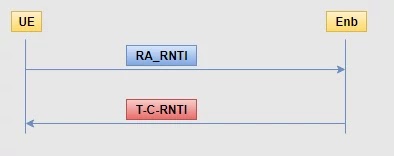
RNTIs
10. This
RAR must be sent to UE on PDSCH channel by reserving PRB.
11. eNB
MAC allocate a PRB for the UE on PDSCH and gives these details [RAR+PDSCH PRB]
to eNB physical.
12. First
eNB phy have to send the PDSCH PRB reservation detail to UE on the PDCCH
channel against RA-RNTI.
13. eNB PHY pack RAR info on PDSCH PRB and
transmit it.
14. UE
PHY always listening to PDCCH to get to know that there is any PRB allocates
against his RA-RNTI on PDSCH.
15. UE
PHY download the specified PRB and decode the info and send it to UE MAC.
16. UE
MAC received RAR which contain many detail .
17. UE
MAC verify the preamble id if matched than UE MAC decided to send “msg3”.
18. “msg3”
is nothing but a RRC connection request message.
19. UE
MAC send msg3 to UE PHY along with PUSCH PRB used for transmit.
20. Also
MAC tells physical layer about how much timing advance must be applied before
Tx.
21. UE
PHY Tx “msg3” by coding into PUSCH PRB indicated.
22. eNB
PHY received this and send to eNB MAC.
23. eNB
MAC will perform the below task:
a.
Send ACK in the name of CRI(refer Ans 19) to UE that I have received msg3.
b.
Send msg3 to higher layer.
24. eNB
reserve a PRB for the UE on the PDSCH against T-C-RNTI to send CRI and send it.
25. UE
MAC compare the CRI received with Tx msg3, if equal than RAP is successful
otherwise failed.
5G Architecture, 5G Core Architecture, 5G NR, 5G NR Architecture, 5gc archtecture

Overview
of the Core Network

- The (Radio) Access Network [(R)AN];
- The User Plane Function
(UPF), handling the user
data;
- The (external) Data
Network (DN);
- The Application Function (AF), handling the application(s);
Overview of the Access Network

References for 5GS
8:38 PM
The 5G SA Core architecture is describe in the following figure.

The SA Architecture
* The SA architecture can be seen as the "full 5G
deployment", not needing any part of a 4G network to operate.
* The NR base station (logical node "gNB")
connects with each other via the Xn interface, and the Access Network (called
the "NG-RAN for SA architecture") connects to the 5GC network using
the NG interface.
* The continuation of this section refers to the SA
architecture, the NSA being addressed in a subsequent, dedicated, section.
Overview
of the Core Network
* In the SA
deployment option, the 5G System (5GS) is composed of the User Equipment, the
Access Network (including the "New Radio" or NR) and the Core Network
(5GC or 5GCN).
* The service
requirements, as presented in the previous clause, were used as a basis to
define the architecture. The architecture specification (also called, Stage 2) started
with a preliminary study in TR 23.799,
also called "NextGen TR", before being fully specified in TS 23.501, TS 23.502 and TS 23.503.
* The 5GC
architecture relies on a so-called "Service-Based Architecture" (SBA)
framework, where the architecture elements are defined in terms of
"Network Functions" (NFs) rather than by "traditional"
Network Entities. Via interfaces of a common framework, any given NF offers its
services to all the other authorized NFs and/or to any "consumers"
that are permitted to make use of these provided services. Such an SBA approach
offers modularity and reusability.
* The basic (SA,
non-roaming) 5G System architecture is shown below (figure introduced by the
editor):

Overview
of the 5G System architecture
At this stage, only the following essential Network Functions and elements
are highlighted here:
- The User Equipment (UE);
- The (Radio) Access Network [(R)AN];
- The User Plane Function
(UPF), handling the user
data;
- The (external) Data
Network (DN);
- Some remarkable Network Functions (NFs):
- The Application Function (AF), handling the application(s);
- The Access and Mobility management Function (AMF), that accesses the UE and the (R)AN;
- The Session Management Function (SMF) that accesses the UPF.
The other NFs are introduced later.
* The SBA (Service
Based Architecture) approach enables a virtualized deployment. Indeed, a
Network Function instance can be deployed as fully distributed, fully
redundant, stateless and/or fully scalable. Several Network Function instances
can be present within a same NF set. Conversely, the services can be provided
from several locations.
* In other words,
when the services of a specific NF are invoked, this virtualization enables to
route the UE's messages to any capable entity (within a pre-defined set of equivalent
NFs).
* This provides
resiliency: any specific instance of the NF can e.g. be turned off for planned
maintenance, and there will be auto-recovery without any service disruption.
Overview of the Access Network
As a first approach, the architecture of
the 5G AN is extremely simple since it consists in one single entity, the gNB,
which connects to the 5G CN via the NG interface. It may also connect to
another gNB via the Xn interface and/or to the 4G's eNB via the X2 interface,
as shown below in the editor-proposed picture inspired from TS 38.401 and TS 38.420. It also connects to the UE via the NR interface,
not shown on the figure. Note that this AN architecture is rather similar in
its principle to what was developed for LTE with the eNB, as can be seen in TS 36.401.

Overview
of the AN interfaces
References for 5GS
The main specifications for the 5G System are:
[1] TS 23.501, "System Architecture for the
5G System"
[2] TS 23.502, "Procedures for the 5G
System"
[3] TS 23.503, "Policy and Charging Control
Framework for the 5G System"
[4] TR 23.799 "Study on Architecture for
Next Generation System"
[5] TS 38.401 " NG-RAN; Architecture description"
[6] TS 38.420 " NG-RAN; Xn general aspects and principles"
[7] TS 36.401 "Evolved Universal Terrestrial
Radio Access Network (E-UTRAN); Architecture description"
Subscribe to:
Posts (Atom)