• Vision
  • About us
  • LTE INTERFACES WITH PROTOCOLS

    Jitendra Kumar


    LTE PROTOCOL INTRODUCTION

    INTRODUCTION OF PROTOCOLS:
    ·   There are three broad categories of Protocols
    o Application Protocols
    o Processing Protocols
    o Delivery Protocols

    ·   Application Protocols: Generate the Information required for the Communication of Nodes to achieve their Functionalities!

    ·   Processing Protocols: Process the Information generated by Application protocols!

    ·   Delivery Protocols: Send the Processed Information from Source to Destination!

    COMPUTER COMMUNICATION PROTOCOLS

     This is work on a principle of OSI communication have 7 layer shown in below. This communication is done by the use of Switches and Router between two computers.
    OSI-LAYER-PROTOCOL

    LTE MOBILE PROTOCOL LAYER

     Its work on Application, Delivery and Processing Protocols.      
    LTE-MOBILE-WIRELESS-PROTOCOL-LAYER

    LTE WIRELESS NETWORK INTERFACES

     There are many Interfaces in LTE network which are mentioned below:

    LTE INTEFACES

    PURPOSE
    LTE-Uu
    Interface between UE to Enb
    X2
    Interface between two adjacent eNBs
    S1-MME
    Interface between eNB to MME
    S1-U
    Interface between eNB to SGW
    S3
    Interface between MME to SGSN
    S4
    Interface between SGW to SGSN
    S5/S8
    Interface between SGW to PGW
    S6a
    Interface between MME to HSS
    S6d
    Interface between SGSN to HSS
    S7/Gx
    Interface between PGW to PCRF
    S9
    Interface between hPCRF to vPCRF
    S10
    Interface between MME to MME
    S11
    Interface between MME to SGW
    S12
    Interface between SGW to RNC
    S13
    Interface between MME to EIR
    S13'
    Interface between SGSN to EIR
    S16
    Interface between SGSN to SGSN
    Gy
    Interface between PGW to OFCS
    Gz
    Interface between PGW to OCS

    Transport Protocols

     There are few Transport Protocol which we need to know before proceed to further:

    ·     TCP: Transmission control Protocol

    o   It’s a connection oriented protocol.
    o   It’s a reliable protocol.
    o   It rearrange the data packet in the order specified.
    o   Speed is slower than UDP because its attempt error recovery process also.
    o   Header size is 20 Bytes
    o   Guaranteed to data delivery.

    ·     UDP: User Datagram Protocol

    o   It’s a connectionless protocol.
    o   It’s not reliable protocol.
    o   It is not rearrange the data packet in the order specified.
    o   Speed is faster because its not attempt error recovery process.
    o   Header size is 8 Bytes
    o   No Guaranteed for data delivery.

    ·  GTP: GPRS Tunneling Protocol

    o   Its used to encapsulate user data when passing through that core network.
    o   It provide mobility when UE is in mobility state, the IP address remain same and packet are still forwarded since tunneling is provide between PGW and eNB via SGW.
    o   There are two types GTPC is used for control plane and  GTPU is used for USER plane.
    o   Main IP is hidden so provided security also.
    ·         SCTP: Stream Control Transmission protocol
    o   It’s a connection oriented protocol.
    o   It’s a reliable protocol.
    o   It rearrange the data packet in the order specified.
    o   It does bundling the message but TCP doesn’t.
    o   Guaranteed to data delivery
    ·         Diameter: Its is a important protocol used for those components whose functionality come under AAA(Authentication, Authorization and Accounting) category. Its not a 3GPP protocol.

    LTE WIRELESS NETWORK PROTOCOLS

     These are the main application and transport protocol used for LTE Network:
    LTE-WIRELESS-NETWORK-PROTOCOLS

    PROTOCOL SUMMARY

    lte-protocol-stack

    Paging in 5GNR

    Joni Tyagi
    paging procedure in 5g
    Paging for 5GS offerings:
    • The network shall initiate the paging procedure for 5GS services or NAS signaling messages or user data is pending and need to be sent to the UE in 5GMM-IDLE mode
    • The paging system is performed by 3GPP network and used for establishment of an NAS signaling connection with UE.
    • The use of paging procedure is to request to the UE to re-establish the user plane resources of PDU sessions for down-link.
    • Another use of the paging technique is to request the UE to re-setup the user-plane resources of PDU session(s) related to non-3GPP.
    • Additionally, the network can use the paging system to provoke the cell terminating SMS.


    5GNR Temporary Identities

    Joni Tyagi
    If we discuss about identities there are multiple identities are present in 5G New Radio network as well as LTE Radio Network. Some identities are uses by User Equipment and some are Network Entities identities. So here I am written almost all identities use in network.

    5G NR Frame Structure

    Joni Tyagi

    5G/NR Frame Structure

    There have been lengthy discussions on frame structure both  in academia and in 3GPP and now we have pretty clear agreements on what a NR (5G) radio body would appearance, like In this page I will describe on NR Frame Structure that is laid out in 3GPP specifications. If you're interested in the ones lengthy discussions and histories about show those specification came out for your personal attraction and study.

    5G/NR Numerology and Sub-Carrier Spacing:   

    Numerology: corresponds to one sub carrier spacing inside the frequency domain. By go up a reference sub carrier spacing by an integer N, special numerology may be defined.
    The numerology is based on exponentially scalable sub-service (sub-carrier spacing) Δf = 2μ × 15 kHz with μ=0, 1, 3, 4 for Primary Synchronize Signal, Secondary Synchronize Signal & PBCH and μ=0, 1, 2, 3 for other channels. Normal CP is supported for all sub-service (sub-carrier) spacing, Extended CP is
    Supported for μ=2. 12 consecutive sub-carriers shape a Physical Resource Block (PRB). Up to 275 PRBs are supported on a provider.

    5G/NR Frame Structure Numerology and Sub-Carrier Spacing

    Frame and Subframe length:

    In 5G/NR Downlink and uplink transmissions are organized into Radio frames with 10 ms length, together with ten 1 ms sub frames. Each radio frame is divided into two equally-sized half-radio frames of 5 sub frames each. The slot duration is 14 symbols with Normal Cyclic Prefix and 12 symbols with Extended Cyclic Prefix, and scales in time as a function of the used sub-carrier spacing so that there is continually an integer no. of slots in a sub frame.

    5G Numerology and Sub-Carrier Spacing

    Supportive transmission numerologies:

    Every numerology can't be used for every physical channel and signals. That is, there is a specific numerologies which are used simplest for a certain kind of physical channels despite the fact that majority of the numerologies may be used any kind of physical channels. Following table is shows which numerology can be used for which physical channel.

    NR Numerology and Sub-Carrier Spacing

    5G/NR OFDM Symbol Duration:  

    As you know that there are multiple numerologies are using in 5G/NR. So the ofdm symbol durations also are changed as per numerology use in physical layer. For e.g. if Numerology 0 is use the ofdm symbol duration is 66.67µs. But if Numerology 4 is use then the ofdm symbol duration is decrease and it would be 4.17µs. please go through with below table for more clarity.

    5g ofdm symbol duration

    5G/NR Numerology Sampling Time:  

    if we take an example of 15Khz sub-carrier  the sampling rate will be Nf=2048. And sampling time is Tc=32.6ns. or if we take an example of 480Khz sub-carrier  the sampling rate will be Nf=4096. And sampling time is Tc=0.509ns.

    5G/NR Numerology Sampling Time


    5G/NR Radio Frame Structure:

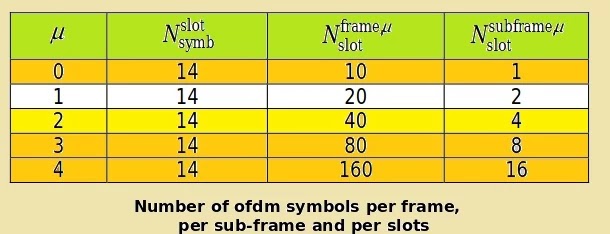
    [Normal Cyclic Prefix, Numerology=0]:  In this configuration, a sub-frame has one (1) slot, it means a radio frame [RF] consists of 10 slots in it. The numbers of OFDM symbols present in a slot is 14.

    5G NR Radio Frame Structure

    5g Numerology complete info

    [Normal Cyclic Prefix, Numerology=1]:  

    In this configuration, a sub-frame has two (2) slots, it means a radio frame [RF] consists of 20 slots in it. The numbers of OFDM symbols present in a slot is 14.
    nr Numerology complete info

    5g normal cyclic prefix

    [Normal Cyclic Prefix, Numerology=2]:  

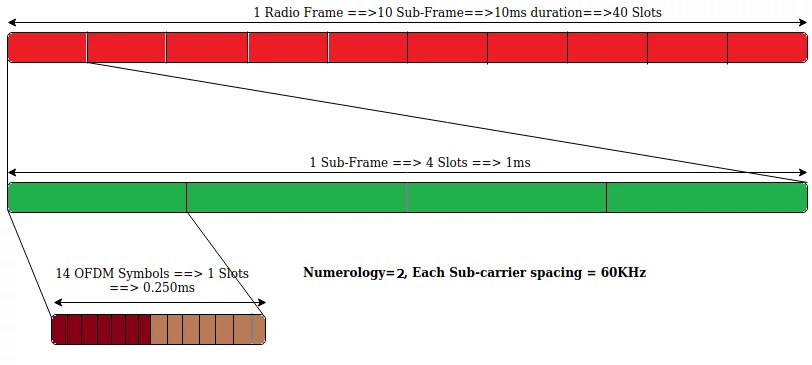
    In this configuration, a sub-frame has four (4) slots, it means a radio frame [RF] consists of 40 slots in it. The numbers of OFDM symbols present in a slot is 14.

    5g normal cyclic prefix

    5g normal cyclic prefix

    [Normal Cyclic Prefix, Numerology=3]:  

    In this configuration, a sub frame has Eight (8) slots, it means a radio frame [RF] consists of 80 slots in it. The numbers of OFDM symbols present in a slot is 14.

    5g normal cyclic prefix

    5g normal cyclic prefix

    [Normal Cyclic Prefix, Numerology=4]:  

    In this configuration, a sub frame has Sixteen (16) slots, it means a radio frame [RF] consists of 160 slots in it. The numbers of OFDM symbols present in a slot is 14.


    [Extended Cyclic Prefix, Numerology=2]: 

    In this configuration, a sub frame has four (4) slots, it means a radio frame [RF] consists of 40 slots in it. The numbers of OFDM symbols present in a slot is 12.


    Extended Cyclic Prefix

    Extended Cyclic Prefix