• Vision
  • About us
  • 5G Random Access Procedure

    Joni Tyagi

    5G Random Access Procedure:


    ·        Why Random Access Procedure Require:
    §  Used for UE UL Synchronization between UE to Network
    §  Require UL Resources for sending Msg3 or data stored in buffer
    §  UE Initial access from RRC_IDLE
    §  Random Access Procedure is always initiated by UE MAC Layer
    §  RRC Connection and RRC Re-establishment procedure
    §  During Handover Time
    §  During RRC_CONNECTED DL or UL data arrival when UE have UL synchronization
    §  Transition from RRC_Idle to RRC_Active State;
    §  To establish time alignment at Secondary Cell addition;
    §  Request for Other System Information
    And Beam failure recovery.

    ·        How many Types of Random Access Procedure:

    Contention Based and Non-Contention Based

    Random Access Procedure types are similar to LTE procedure.
    Contention Based RAP: - Collision possible on PRACH Transmissions from several UE’s.
    5G-Random-Access-Procedure-Contention-based

    §  Non Contention Based RAP: - Collisions will be avoided as Network allocates special pattern and special PRACH Resources.
    5G-Random-Access-Procedure-non-contention-based

    *UE MAC Randomly select a preamble from a 64 preambles broadcast in PDCCH by network. How?
    Preamble Sequence Generation

    In UE MAC Zadoff-chu sequence generation is used for generate preamble and it have a property to convert actual no. into complex no. (The complex no. having different angular values)
    random-access-Zadoff-chu-sequence

    From which frequency domain sequence generated 
    random-access-Zadoff-chu-sequence

    Where LRA = 839 or LRA = 139 depending on the PRACH preamble format define below:
    PRACH-Preamble-formats

    5g-PRACH-Preamble-formats
    Long Preamble Features:

    §  A long preamble with 1.25 kHz numerology holds 6 resource blocks in the frequency domain, while a preamble with 5 kHz numerology holds 24 resource blocks.
    §  The Long preambles are based on a sequence length is L = 839
    §  Sub-carrier spacing can be 1.25 Khz or 5 Khz for long preamble
    §  Numerology used for long preambles is different from any other NR broadcast
    §  Origin of long preambles partly from preamble used for LTE
    §  Long preambles can only be used for FR1 frequency bands that are less than 6000 Mhz (6 Ghz)
    §  There are 4 different formats for long preface names format # 0, format # 1, format # 2 and format # 3
    §  NR preamble formats 0 and 1 are similar to LTE preamble formats 0 and 2
    The above 64 preambles are using, have 4 formats and are using in generally Numerology 0 which is similar with 4G. But in 5G we have 4 others Numerologies which are used for higher bands. So total 13 different preambles formats are used in 5G.

    The below table shown FR2 preamble formats:
    fr2-PRACH-Preamble-formats

    Short Preamble Features:
    §  The Short preambles are based on a sequence length L is = 139
    §  The sub-carrier spacing for the short-preamble is aligned with the normal NR sub-carrier spacing i.e. 15 KHz, 30 KHz, 60 KHz and 120 KHz.
    §  Short preambles use subcarrier spacing of the following:
    §  In case of operation below 6 GHz (FR1) of 15 KHz or 30 KHz.
    §  60 Khz or 120 Khz in case of operation in high NR frequency band (FR2).
    §  A short preamble holds 12 resource blocks in the frequency domain regardless of numerology
    §  Short preambles are generally shorter than longer preambles and often feature only a few OFDM symbols.
    §  Short preamble formats are designed such that the end of each OFDM symbol acts as a CP for the next OFDM symbol and the length of the preamble OFDM symbol is equal to the data of the OFDM symbol

    §  In most cases it is therefore possible that multiple preamble transmissions within the same RACH slot (opportunity) are collide in a time. In other words, for short previews there may be multiple RACH opportunities in a single RACH slot in the frequency domain as well as in the time domain.

    §  The 5G NR supports a mix of "A" and "B" formats to enable additional formats such as A1 / B1, A2 / B2, and A3 / B3.
    §  The short Preamble formats are the same except for some short cyclic prefixes for the A and B, B formats.
    §  The preamble formats B2 and B3 are always used in combination with the corresponding A formats (A2 and A3)
    §  Micro-preambles are designed to target small / common cell and indoor deployment scenarios.
    §  Short preambles allow gNB receivers to use the same fast Fourier transform (FFT) for data and random-access premature detection.
    §  These preambles are composed of several small OFDM symbols per second preamble, making them more robust against periodic channels and frequency errors.
    §  The short preambles supports analog beam sweeping during PRACH reception, so that the same preamble can be obtained with different beams at GBB
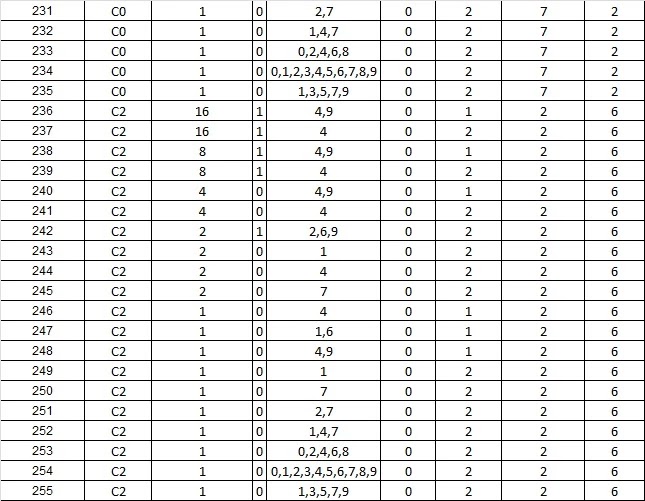
    *After that UE mac gives this preamble’s to ue’s physical for dispatch via PRACH resources:
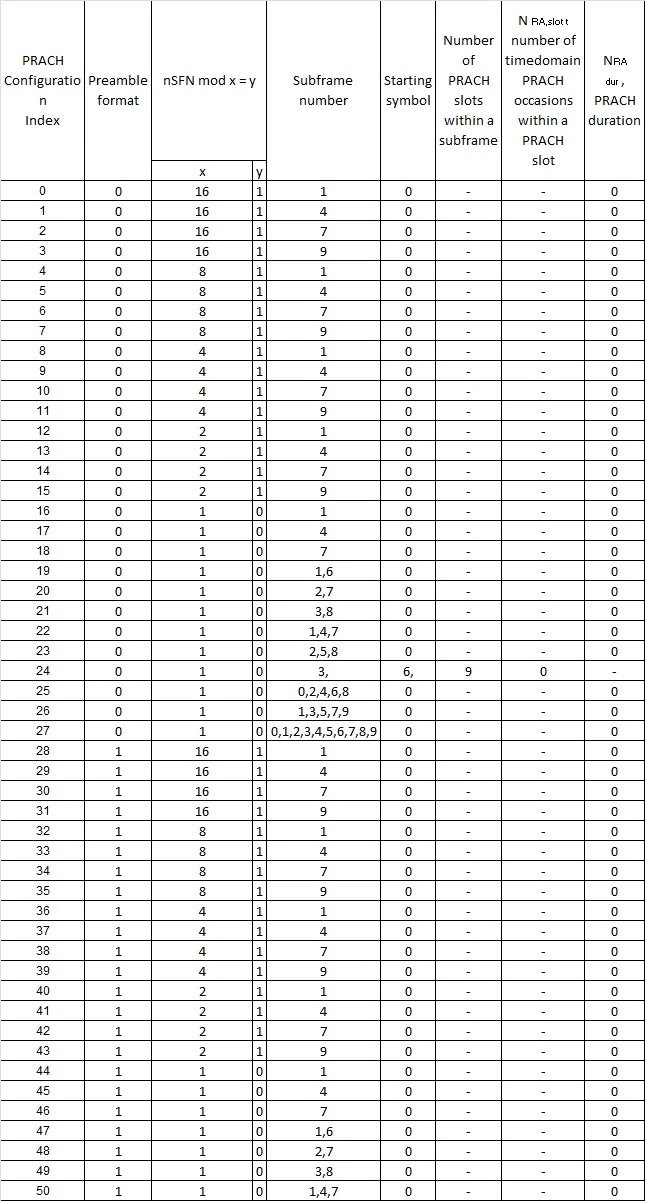
    5g-PRACH-resources
    5g-PRACH-resources
    5g-PRACH-resources
    5g-PRACH-resources-formats
    5g-PRACH-resources-info

    *Now UE physical layer calculate RA_RNTI:
    RA-RNTI= 1 + s_id + 14 × t_id + 14 × 80 × f_id + 14 × 80 × 8 × ul_carrier_id
    Zero Correlation Zone:
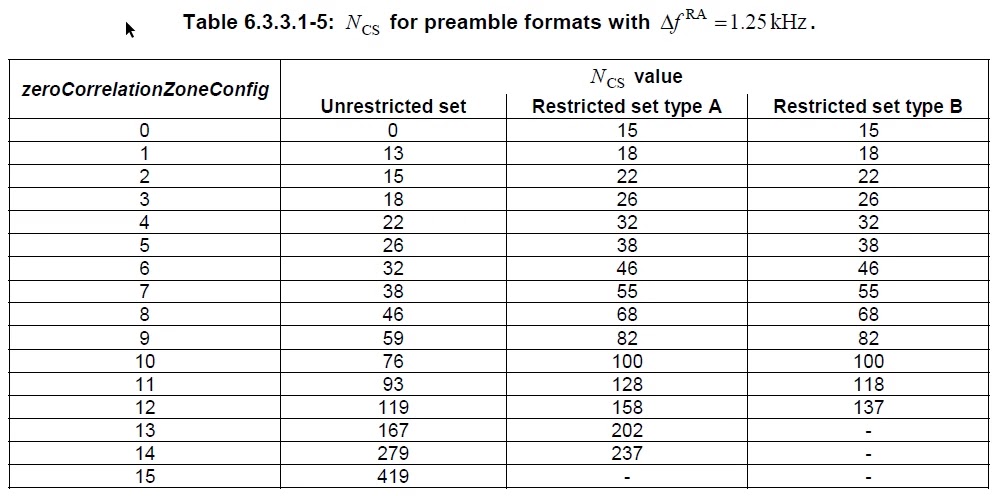
    5g-zero-correlation-zone-config
    nr-zero-correlation-zone-config
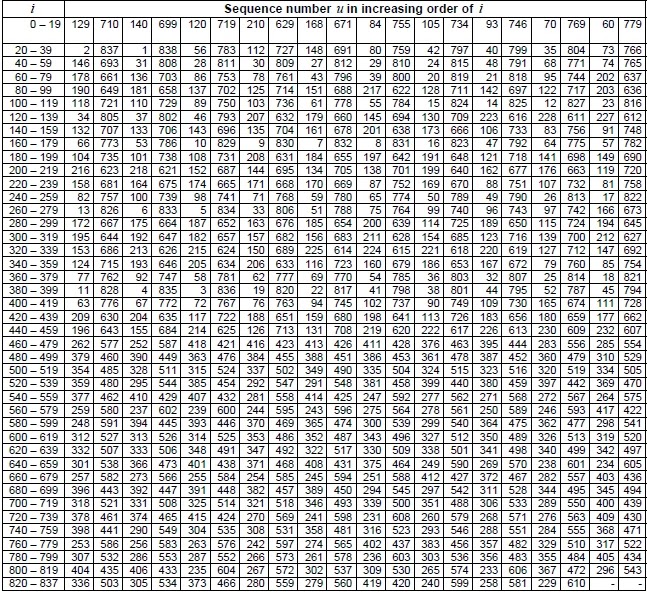
    Root Sequence:
    5g-Root-Sequence
    nr-Root-Sequence
    *RRC layer configure the following parameters for RAP:


    - prach-ConfigurationIndex: Provide the set of PRACH occasions for the transmission of the Random Access Preamble
    - preambleReceivedTargetPower: initial Random Access Preamble received power;
    - rsrp-ThresholdSSB: This RSRP threshold is used for the selection of the SSB and corresponding Random Access Preamble and PRACH occasion. If the Random Access procedure is initiated for beam failure recovery, rsrp-ThresholdSSB used for the selection of the SSB within candidateBeamRSList refers to rsrp-ThresholdSSB in BeamFailureRecoveryConfig IE;
    - rsrp-ThresholdCSI-RS: This RSRP threshold is used for the selection of CSI-RS and corresponding Random Access Preamble and PRACH occasion. If the Random Access procedure is initiated for beam failure recovery, rsrp-ThresholdCSI-RS shall be set to a value calculated by multiplying rsrp-ThresholdSSB in BeamFailureRecoveryConfig IE by powerControlOffset as specified in TS 38.214 [6];
    - rsrp-ThresholdSSB-SUL: This RSRP threshold is used for the selection between the NUL carrier and the SUL carrier;
    - candidateBeamRSList: list of reference signals (CSI-RS and/or SSB) is used to identifying the candidate beams for recovery and the associated Random Access parameters;
    - powerControlOffset: a power control offset present between rsrp-ThresholdSSB and rsrp-ThresholdCSI-RS and it’s used when the Random Access procedure is initiated for beam failure recovery.
    - powerRampingStep: the power-ramping factor is used to increase preamble transmit power.
    - powerRampingStepHighPriority: in case of differentiated Random Access procedure the power-ramping factor is used.
    - scalingFactorBI: The scaling factor is used for differentiated Random Access procedure;
    - ra-PreambleIndex: nothing but Random Access Preamble;
    - ra-ssb-OccasionMaskIndex: defines PRACH occasion(s) associated with an SSB in which the MAC entity may transmit a Random Access Preamble (see spec 36.321 subclause 7.4).
    - ra-OccasionList: It defines PRACH occasion’s associated with a CSI-RS in which the MAC entity may transmit a Random Access Preamble;
    - ra-PreambleStartIndex: the starting index of Random Access reamble(s) for on-demand SI request;
    - preambleTransMax: used to count maximum number of Random Access Preamble transmission.
    The UE MAC entity handles the RAP procedure in transport Channels called Random Access Channel
    * When UE is configured with SCG (Secondary Cell Group) than 2 MAC entities configured 1st for MCG (Master Cell Group) and 2nd for SCG.
    *The timers and parameters are used in each MAC entities are configured independently else specified.
    *The Serving Cells, CRNTI, Radio Bearers, Logical CHannels, Upper and Lower layer entities, LCGs, and HARQ entities considered by each MAC entity.
    *If the MAC entity is configured with 1’s or more SCells (Secondary Cells), there are multiple DL-SCH and there may be multiple ULSCH as well as multiple RACH have per MAC entity.
    * And 1’s DLSCH, 0’s or 1’s UL-SCH and 0’s or 1’s RACH for each Secondary Cell
    *Or 1’s DL-SCH, 1’s UL-SCH, and 1’s RACH on the Special Cell.
    ** If MAC entity is not configured with any Secondary Cell, than there is 1’s DL-SCH, 1’s UL-SCH, and 1’s RACH per MAC entity.

    5G Protocol Stack

    Joni Tyagi

    5G Protocol Stack:

    The 5G protocol stack is similar to the 4G protocol stack, but has some changes. If I talk about the changes, what kind of changes happen in 5G, then let me tell you that some new components have been introduced and 4G has some limitations, which have been overcome in 5G, So obviously some changes are needed. Therefore in 5g protocol stack the only one new layer is introduced is SDAP layer (in user plane only); present between rrc and pdcp and other protocols are same.
    So here I am sharing the 5G control plane protocol stack here and user plane below:
    5G-Control-Plane-Protocol-Stack

    5G Control Plane Protocol Stack; between the UE and the 5G Core:

    First I am sharing the details of 5G control plane; In the picture above you will get an idea of ​​ue's protocol stack in 5g core components, 


    In below picture define brief detail of NAS layer and the lower layer is mentioned in the picture, are RRC; and transport layers PDCP, RLC, MAC, PHYSICAL layer. More importantly, the AMF has only the NAS layer, the transport layers are absent in the AMF.
    5G-Control-Plane-Protocol-Stack-between-the-UE-and-the-5G-Core
    A single N1 NAS signaling connection is used for each received entry to which the UE is attached. The single N1 endpoint is placed in the AMF. Single N1 NAS signaling connections are used for both registration management and connection management (RM / CM) and for SME-related messages and tactics for UEs.
    The NAS protocol on N1 includes the NAS-mobility management and NAS-session management components.
    There is more than one case of protocol between the UE and the core network function (excluding AMF) that needs to be carried over the N1 through NAS-MM protocol. Such examples include:
    - Session Management Signalling.
    - SMS.
    - UE Policy.
    - LCS.
    RM/CM NAS messages in NAS-MM and other forms of NAS messages (e.g. SM), as well as the corresponding methods, are decoupled.
    The NAS-MM supports generic talents:
    => NAS techniques that terminate on the AMF. This includes:
    => Registration management and connection management with UE handles state machines and technologies, including NAS shipping; AMF supports the following skills:
    -- Decide whether to just accept the RM/CM a part of N1 signalling in the course of the RM/CM strategies without thinking about probable mixed different non NAS-MM messages (e.g., SM) inside the same NAS signalling contents;
    -- Know if one NAS message must be routed to every other NF (e.g., SMF), or domestically processed with the NAS routing capabilities inside at some stage in the RM/CM procedures; 
    -- Provide a secure NAS signalling connection (integrity protection, ciphering) between the UE and the AMF, together with for the delivery of payload;
    -- Provide get right of entry to control if it applies;
    -- It is viable to transmit the different form of NAS message (e.g., NAS SM) together with an RM/CM NAS message with the aid of helping NAS shipping of different varieties of payload or messages that don't terminate on the AMF, i.e. NAS-Session Management, SMS, User Equipment Policy and LCS between the UE and the AMF. This includes:
    -- Information approximately the Payload type;
    -- Additional Information for forwarding purposes
    -- The Payload (e.g. The SM message within the case of SM signalling);
    -- There is a Single NAS protocol that applies on both 3GPP and non-3GPP get entry to. When an UE is served via a single AMF whilst the UE is attached over a couple of (3GPP/Non 3GPP) accesses, there is a N1 NAS signalling connection in line with get admission to.
    Security of the NAS messages is provided based totally on the security context installed among the UE and the AMF.

    5G-R(AN) and the AMF Control Plane:

    5G-AN-and-the-AMF-Control-Plane
    Figure 1 5G-AN and the AMF Control Plane

    -          NG-AP (Application Protocol): Is a Application Layer Protocol between the 5G-AN node and the AMF. NG-AP.
    -          Stream Control Transmission Protocol (SCTP): This protocol ensures transport of signalling messages among AMF and 5G-AN node (N2). SCTP.

    5G-R(AN) and the SMF Control Plane via AMF:

     5G-R(AN)-and-the-SMF-Control-Plane-via-AMF
    -          N2 SM information: This is the subset of NG-AP statistics that the AMF transparently relays among the AN and the SMF, and is included inside the NG-AP messages and the N11 associated messages.

    Control Plane Between UE to 5G-AN and AMF: 

    Control-Plane-Between-UE-to-5G-AN-and-AMF
    Legend:
    - NAS-MM: The NAS protocol for MM capability supports registration management capability, connection management capability and user plane connection activation and deactivation. It is also responsible of ciphering and integrity safety of NAS signalling.
    - 5G-AN Protocol layer: This set of protocols/layers relies upon on the 5G-AN. In the case of NG-RAN, the radio protocol among the UE and the NG-RAN node (eNodeB or gNodeB) is laid out.

    Control Plane Between UE to 5G-AN and AMF to SMF: 

    Control-Plane-Between-UE-to-5G-AN-and-AMF-to-SMF

    The NAS-SM helps the coping with of Session Management among the UE and the SMF.
    The SM signalling message is handled, i.e. Created and processed, inside the NAS-SM layer of UE and the SMF. The content material of the SM signalling message isn't always interpreted with the aid of the AMF.
    The NAS-Mobility Management layer handles the Session Management signalling is as follows:
    -- For transmission of SM signalling:
    - The NAS-MM layer creates a NAS-MM message, which include protection header, indicating NAS transport of SM signalling, additional data for the receiving NAS-MM to derive how and where to forward the SM signalling message.
    -- For reception of SM signalling:
    - The receiving NAS-MM techniques the NAS-MM part of the message, i.e. plays integrity check, and translates the additional statistics to derive how and wherein to derive the SM signalling message.
    The SM message part shall encompass the PDU Session ID.

    5G User Plane Protocol Stack:
    5G-User-Plane-Protocol-Stack

    5G-User-Plane-Protocol-Stack-between-UE-to-UPF
    -        PDU layer: This layer corresponds to the PDU made between the UE and the data network (DN) above the PDU session. When the PDU session type is IPv4 or IPv6 or IPv4v6, it matches the IPv4 packet or IPv6 packet or each of them; When the PDU session type is Ethernet, it matches the Ethernet frame; e.t.c
    -        GPRS Tunneling Protocol (GTP-U) for User Plane: This protocol supports visitors to various PDU sessions (possibly corresponding to unique PDU session types) with the help of user records (i.e between 5G-AN nodes) for N3 is Does, (UPF) inside the backbone network. GTP will face all rejected user PDUs. This corresponds to the PDU session level. This layer carries forward the notation associated with the QoS flow.
    -        5G Encapsulation: This layer supports separate PDU sessions on N9 (all corresponding to a unique PDU session type) (such as between specific UPFs of 5G). This corresponds to the PDU session level. This layer contains notation associated with QoS flow.
    - 5G-AN protocol stack: This set of protocols/layers depends at the AN:
    -          When the 5G-AN is a 3GPP NG-RAN, these protocols/layers are described in TS 38.401 [42]. The radio protocol among the UE and the 5G-AN node (eNodeB or gNodeB) is laid out in TS 36.300 [30] and TS 38.300 [27].
    -          When the AN is an Untrusted non 3GPP get entry to to 5GC the 5G-AN interfaces with the 5GC at a N3IWF defined in clause 4.3.2 and the 5G-AN protocol stack is defined in clause 8.3.2.
    - UDP/IP: These are the main communication protocols.
    -          NOTE 1: The wide variety of UPF inside the facts route is not constrained through 3GPP specifications: there can be inside the information path of a PDU Session 0, 1 or multiple UPF that don't help a PDU Session Anchor capability for this PDU Session.
    -          NOTE 2: The "non PDU Session Anchor" UPF depicted in the Figure.
    -          NOTE 3: The N9 interface can be intra-PLMN or inter PLMN (in the case of Home Routed deployment).
    If there's an UL CL (Uplink Classifier) or a Branching Point (each described in clause 5.6.4) inside the data direction of a PDU Session, the UL CL or Branching Point acts because the non PDU Session Anchor UPF. In that case there are a couple of N9 interfaces branching out of the UL CL / Branching Point every main to extraordinary PDU Session anchors.
    -          NOTE 4: Co-vicinity of the UL CL or Branching Point with a PDU Session Anchor is a deployment option.

    LTE Frame Structure

    Jitendra Kumar

    LTE FDD FRAME:

    FDD Frame used for FDD technology.FDD is frequency division duplex which have different frequencies for both DL and UL at a same time. Below mentioned FDD frame.                                                                                                                                          see 5G frame structure
    LTE-FDD-FRAME-structure

    Levels in FDD Frame             see frame structure interview que & ans

    1st Level
    1 Radio Frame=10 ms
    Short CP=140 ofdm symbols and Long CP=120 ofdm symbols
    2nd Level
    1 Sub frame=1ms
    Short CP=14 ofdm symbols and Long CP=12 ofdm symbols
    3rd Level
    1 Time slot=0.5ms
    Short CP=7 ofdm symbols and Long CP=6 ofdm symbols.

    TIME UNIT IN LTE

    ·         Ts(Standard Time in LTE)= 1/(15000*2048)sec-->32ns
    v  It’s a smallest unit of time in LTE operation
    ·         Tslot=15360Ts=15360(1/(15000*2048))-->0.5ms
    ·         A sub frame is equal to 30720Ts=1ms
    ·         A Radio frame is equal to 307200Ts=10ms
    ·         A radio frame = 20 Tslot

    LTE TIME SLOT DIVISION

    Time slot having two categories

    ·         Short CP Time slot

    lte-Short-Cyclic-Prefix-Time-slot

    ·         Long CP Time slot:

    lte-long-Cyclic-Prefix-Time-slot

    LTE TDD FRAME:

    In TDD (Time division duplex) technique we are using, same frequency or frame for both DL and UL but at a different time.
    ·         It consists in a category of Frame 2
    ·         Radio frame size= 10 ms
    ·         Sub-frame size=  1 ms
    ·         Time slot size= 0.5 ms
    ·         Each Radio frame consists two half frames.

    LTE-TDD-FRAME-structure
    TDD have a special sub frame (1,6) when downlink-to-uplink switch-point-periodicity is 5ms.
    TDD have a special sub frame (1) when downlink-to-uplink switch-point-periodicity is 10ms.
    Special Sub-frame carries following info:
    DwPTS: Downlink pilot time slot
    UpPTS: Uplink pilot time slot
    Guard time: It is time using for switching from downlink to uplink so that interference can be eliminated.

    LTE TDD UPLINK AND DOWNLINK CONFIGURATION:

    TDD-UPLINK-AND-DOWNLINK-frame-structure
    *Note: operators choose any 1 configuration out of (7 configurations) as per their users requirements.        see LTE Protocol interview que & ans