• Vision
  • About us
  • 5G NR Frame Structure

    Joni Tyagi

    5G/NR Frame Structure

    There have been lengthy discussions on frame structure both  in academia and in 3GPP and now we have pretty clear agreements on what a NR (5G) radio body would appearance, like In this page I will describe on NR Frame Structure that is laid out in 3GPP specifications. If you're interested in the ones lengthy discussions and histories about show those specification came out for your personal attraction and study.

    5G/NR Numerology and Sub-Carrier Spacing:   

    Numerology: corresponds to one sub carrier spacing inside the frequency domain. By go up a reference sub carrier spacing by an integer N, special numerology may be defined.
    The numerology is based on exponentially scalable sub-service (sub-carrier spacing) Δf = 2μ × 15 kHz with μ=0, 1, 3, 4 for Primary Synchronize Signal, Secondary Synchronize Signal & PBCH and μ=0, 1, 2, 3 for other channels. Normal CP is supported for all sub-service (sub-carrier) spacing, Extended CP is
    Supported for μ=2. 12 consecutive sub-carriers shape a Physical Resource Block (PRB). Up to 275 PRBs are supported on a provider.

    5G/NR Frame Structure Numerology and Sub-Carrier Spacing

    Frame and Subframe length:

    In 5G/NR Downlink and uplink transmissions are organized into Radio frames with 10 ms length, together with ten 1 ms sub frames. Each radio frame is divided into two equally-sized half-radio frames of 5 sub frames each. The slot duration is 14 symbols with Normal Cyclic Prefix and 12 symbols with Extended Cyclic Prefix, and scales in time as a function of the used sub-carrier spacing so that there is continually an integer no. of slots in a sub frame.

    5G Numerology and Sub-Carrier Spacing

    Supportive transmission numerologies:

    Every numerology can't be used for every physical channel and signals. That is, there is a specific numerologies which are used simplest for a certain kind of physical channels despite the fact that majority of the numerologies may be used any kind of physical channels. Following table is shows which numerology can be used for which physical channel.

    NR Numerology and Sub-Carrier Spacing

    5G/NR OFDM Symbol Duration:  

    As you know that there are multiple numerologies are using in 5G/NR. So the ofdm symbol durations also are changed as per numerology use in physical layer. For e.g. if Numerology 0 is use the ofdm symbol duration is 66.67µs. But if Numerology 4 is use then the ofdm symbol duration is decrease and it would be 4.17µs. please go through with below table for more clarity.

    5g ofdm symbol duration

    5G/NR Numerology Sampling Time:  

    if we take an example of 15Khz sub-carrier  the sampling rate will be Nf=2048. And sampling time is Tc=32.6ns. or if we take an example of 480Khz sub-carrier  the sampling rate will be Nf=4096. And sampling time is Tc=0.509ns.

    5G/NR Numerology Sampling Time


    5G/NR Radio Frame Structure:

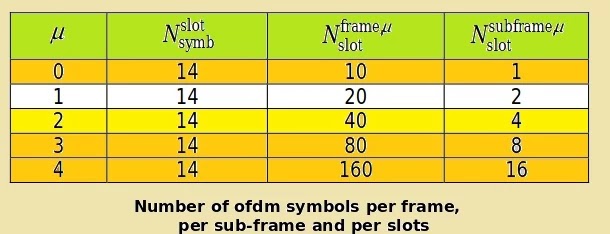
    [Normal Cyclic Prefix, Numerology=0]:  In this configuration, a sub-frame has one (1) slot, it means a radio frame [RF] consists of 10 slots in it. The numbers of OFDM symbols present in a slot is 14.

    5G NR Radio Frame Structure

    5g Numerology complete info

    [Normal Cyclic Prefix, Numerology=1]:  

    In this configuration, a sub-frame has two (2) slots, it means a radio frame [RF] consists of 20 slots in it. The numbers of OFDM symbols present in a slot is 14.
    nr Numerology complete info

    5g normal cyclic prefix

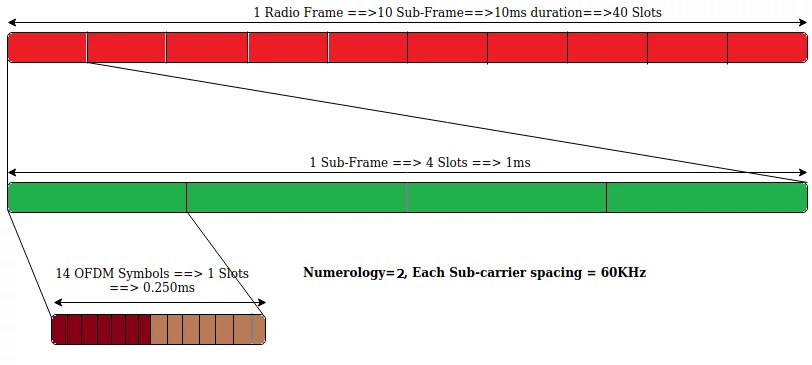
    [Normal Cyclic Prefix, Numerology=2]:  

    In this configuration, a sub-frame has four (4) slots, it means a radio frame [RF] consists of 40 slots in it. The numbers of OFDM symbols present in a slot is 14.
    5g normal cyclic prefix

    5g normal cyclic prefix

    [Normal Cyclic Prefix, Numerology=3]:  

    In this configuration, a sub frame has Eight (8) slots, it means a radio frame [RF] consists of 80 slots in it. The numbers of OFDM symbols present in a slot is 14.

    5g normal cyclic prefix

    5g normal cyclic prefix

    [Normal Cyclic Prefix, Numerology=4]:  

    In this configuration, a sub frame has Sixteen (16) slots, it means a radio frame [RF] consists of 160 slots in it. The numbers of OFDM symbols present in a slot is 14.


    [Extended Cyclic Prefix, Numerology=2]: 

    In this configuration, a sub frame has four (4) slots, it means a radio frame [RF] consists of 40 slots in it. The numbers of OFDM symbols present in a slot is 12.


    Extended Cyclic Prefix

    Extended Cyclic Prefix

    5G Architecture 3gpp

    Joni Tyagi

    5G Architecture 3gpp:

    5G Architecture 3gpp
    An NG-RAN node is either:
    -  a gNB, presenting NR user plane and control plane protocol terminations in the direction of the UE
    -  an ng-eNB, providing E-UTRA user plane and control plane protocol terminations in the direction of the UE.
    The gNBs and new generation [ng-eNBs] are inter-connected with each other by using the Xn interface. The gNBs and [ng-eNBs] are additionally connected by the NG interfaces to the 5GC, more specially to the AMF (Access and Mobility Management Function) with the aid of the NG-C interface and to the UPF (User Plane Function) by way of the NG-U interface.
    NOTE: The architecture and the F1 interface for a functional split are described.
    The New Generation-(RAN) architecture is defined in Figure above.

    Functional Split:The gNB and ng-eNB host the following functions:

    - Function for Radio Resource Management [RRM]: Radio Bearer Control [RBC], Radio Admission Control [RAC], Connection
    Mobility Control, Dynamic allocation of sources to UEs in each uplink and downlink (scheduling);
    IP header compression, encryption and integrity protection facts;
    - Selection of an Access Mobility Function at UE attachment while no routing to an AMF may be determined from the statistics supplied by using the UE;
    - Routing of User Plane statistics closer to UPF(s);
    - Routing of Control Plane statistics toward AMF;
    - Connection setup and release;
    - Scheduling and transmission of paging messages;
    - Scheduling and transmission of device broadcast facts (originated from the AMF or OAM);
    - Measurement and dimension reporting configuration for mobility and scheduling;
    - Transport level packet marking inside the uplink;
    - Session Management;
    - Support of Network Slicing;
    - QoS Flow management and mapping to statistics radio bearers;
    - Support of UEs in RRC_INACTIVE state;
    - Distribution feature for NAS messages;
    - Radio access community sharing;
    - Dual Connectivity;
    - Tight interworking between NR and E-UTRA.

    The AMF hosts the subsequent essential functions:

    - NAS signalling termination;
    - NAS signalling security;
    - AS Security manipulate;
    - Inter CN node signalling for mobility among 3GPP access networks;
    - Idle mode UE Reachability (including manage and execution of paging retransmission);
    - Registration Area management;
    - Support of intra-machine and inter-system mobility;
    - Access Authentication;
    - Access Authorization including take a look at of roaming rights;
    - Mobility management manage (subscription and policies);
    - Support of Network Slicing;
    - SMF selection.

    The UPF hosts the following principal functions:

    - Anchor factor for Intra-/Inter-RAT mobility;
    - External PDU session factor of interconnect to Data Network;
    - Packet routing & forwarding;
    - Traffic usage reporting;
    - Uplink classifier to guide routing site visitors flows to a data network;
    - Branching factor to assist multi-homed PDU session;
    - QoS coping with for user plane, e.G. Packet filtering, gating, UL/DL fee enforcement;
    - Uplink Traffic verification (SDF to QoS float mapping);
    - Downlink packet buffering and downlink facts notification triggering.

    The Session Management function (SMF) hosts the following major functions:

    - Session Management;
    - UE IP cope with allocation and management;
    - Selection and control of UP function;
    - Configures traffic guidance at UPF to route visitors to right destination;
    - Control a part of policy enforcement and QoS;
    - Downlink Data Notification.
    This is summarized at the figure below wherein yellow bins depict the logical nodes and white packing containers depict the fundamental functions.
    SMF AMF GNB function


    5G RAN Architecture 3GPP

    Joni Tyagi

    5G RAN Architecture 3GPP:

    5G RAN Architecture 3GPP

    5G RAN Architecture and concepts:

    The 5G RAN architecture is described to guide facts connectivity and offerings enabling deployments to use techniques such as e.g. Network Function Virtualization and Software Defined Networking. The 5G RAN Architecture shall leverage service-based totally interactions among Control Plane (CP) Network Functions wherein identified. Some key concepts and idea are to:

    ·         Separate the (UP) functions from the (CP) functions, allowing independent scalability, evolution and flexible deployments e.g. Centralized region or distributed (remote) region.

    ·         Enable flexible and efficient network slicing.

    ·         Minimize dependencies among the Access Network (AN) and the Core Network (CN). The structure is described with a converged core community with a common AN - CN interface which integrates different Access Types e.g. 3GPP get entry to and non-3GPP get right of entry to.

    ·         Support a unified authentication framework.

    ·         Support "stateless" NFs, wherein the "compute" resource is decoupled from the "storage" aid.

    ·         Support capability exposure.

    ·         Support concurrent get right of entry to neighboring and centralized services. To assist low latency services and get admission to neighboring information networks, UP functions can be deployed near the Access Network.

    ·         Support roaming with each Home routed traffic in addition to Local breakout site visitors within the visited PLMN.

    ·         Wherever applicable, outline procedures (i.e. the set of interactions between network functions) as offerings, so that their re-use is possible.

    Enable every Network Function to have interaction with other NF at once if required. The structure does not preclude the usage of an intermediate characteristic to help direction Control Plane messages (e.g. Like a DRA).

    5G Core Architecture

    Joni Tyagi

    5G Core Architecture:

    This article describes the architecture for the 5G System. The 5G architecture is described as service-based and the interplay between network functions is represented in two ways.

    ·         A service-primarily based illustration, where network functions (e.g. AMF) inside the Control Plane enables other authorized network functions access to their services. This representation also consists of factor-to-point reference factors in which necessary.

    ·         A reference point representation, indicates the interaction exist between the NF offerings within the network functions described by point-to-point reference factor (e.g. N11) between any network functions (e.g. AMF and SMF).

    5G-Core-Architecture

    Network Functions and entities

    ·         User Equipment (UE)
    ·         (Radio) Access Network ((R)AN)
    ·         Access and Mobility Management Function (AMF)
    ·         User Plane Function (UPF)
    ·         Session Management Function (SMF)
    ·         Policy Control Function (PCF)
    ·         Application Function (AF)
    ·         Data Network (DN), e.g. Operator offerings, Internet get entry to or 3rd birthday celebration offerings
    ·         Authentication Server Function (AUSF)
    ·         Unified Data Management
    ·         Unified Data Repository
    ·         Unstructured Data Storage Function (UDSF)
    ·         Network Exposure Function (NEF)
    ·         Network Repository Function (NRF)
    ·         Network Slice Selection Function (NSSF)
    ·         5G-Equipment Identity Register (5G-EIR)

    LTE ARCHITECTURE

    Joni Tyagi

    LTE (LONG TERM EVOLUTION) ARCHITECTURE


    HISTORY

    • Two Systems that impacted almost every Human Life
    • (i)   Mobile Communication Via 2G Networks.
    • (ii)  Wired & Wireless Data Connectivity via xDSL & WLAN 802.11 a/b/g standards.
    • 3G Networks is the first major step towards the convergence of both these technologies
    THE WAY TO LTE-3G LIMITATIONS
         The ‘Maximum Bit Rates’ are still in the range of 20mbps
         This is way behind the other popular wireless technologies like
         WiFi: 802.11 a/b/g/n
         WiMax: 802.16 e/m
         The ‘Latency’ of User Plane Traffic (UMTS > 30ms) and Resource
         Management Procedures (UMTS > 100ms) is still too high
         The ‘Terminal Complexity’ of WCDMA systems is quite high, and resulting
    (i)                  Expensive Equipment
    (ii)                 Poor Performance
    LTE GOALS
         The ‘Terminal Complexity’ of WCDMA systems is quite high, and resulting
         It shall Compete especially with 802.16e/m in data rates
         It must retain the high mobility features of GSM/UMTS
    LTE SAE DIAGRAM AND FEATURES
    LTE-ARCHITECTURE

    LTE SAE DIAGRAM

    LTE FEATURES:

    ·         Simplify the RAN: Reduced the number of RAN Nodes and Interfaces.
    ·         Reduce Latency.
    ·         Increase Throughput and Improve Spectrum Efficiency.
    ·         Flexibility in using Frequency Bands.
    ·         Migrate to Optimized PS Domain with no CS Domain.
    ·         Flat Architecture: Minimize the risk of single point of failures in the network.
    ·         Efficient Inter-working between 3G and Non-3G specified systems.
    ·         Improve Terminal Power Efficiency.
    ·         All IP Transport Network.
    WIRELESS TECHNOLOGY COMPARISON
    WIRELESS-TECHNOLOGY-COMPARISON

    LTE /SAE INTERFACE ARCHITECTURE
    LTE /SAE-INTERFACE-ARCHITECTURE

    NETWORK ELEMENT FUNCTIONS

    eNODE B Functons:

    ·         Only Network Element in EUTRAN.
    ·         eNB Can Handle Several Cells.
    ·         Radio Admission Control & Radio Resource Management(RRM) Dynamic   Resource Allocation(Scheduler).
    ·         Radio Bearer Mgmt: Setup, Modification and Release.
    ·         UE Connection State Management and UE-MME Connection MME Selection at   the Attach of the UE.
    ·         Measurements Collection and Evaluation.
    ·         Handover Decisions and Triggering. eNB-eNB Connections to Handle HO   Ciphering and Integrity Protection.
    ·         IP Header Compression and Decompression User Data Routing between UE and   SAE-GW System Information Broadcasting.
    ·         Transmission of Paging Messages to UEs.

    MME Functons:

    ·         Pure Signalling Entity in EPC. Contains VLR Functionality with-in!
    ·         Subscriber Attach/Detach: Non-Access Signalling (NAS).
    ·         Idle State Mobility Handling: Tracking Area Updates.
    ·         MME-MME Connections to Handle Handovers & TAUs.
    ·         Signalling Co-Ordination For SAE Bearer Setup & Modification & Release.
    ·         Security (Authentication, Ciphering, Integrity Protection.
    ·         Trigger and Distribution of Paging Messages to Enb.
    ·         Roaming Control with the Connection to HSS.
    ·         A UE can use the Services of only one MME At Any Given Time!

    HSS Functons:

    ·         Permanent and Central subscriber Database.
    ·         Stores Mobility and Service Data For Each Subscriber.
    ·         Contains Authentication Centre Functionality also.

    EIR Functons:

    ·         IMEI Validation.
    ·         MME Interacts with EIR to Validate the IMEI of a UE.
    ·         Maintains White, Grey, and Black Lists of IMEIs.

    PCRF Functons:

    ·         QoS Handling Function
    ·         QoS Policy Negotiation with PDN
    ·         Validates the QoS of EPS Bearers Requested by EPC As well
    ·         Charging Policy: Determines how the Packets should be Accounted
    ·         PCRF to Provide Policy and Charging Rules Every time a Bearer is Se!

    SGW Functons:

    ·         Packet Data Anchoring Function With in EPC.
    ·         Receives UL Data From eNB/SGSN and Transmits to PGW.
    ·         Receives DL Data From PGW and Transmits to eNB/SGSN.
    ·         local Mobility Anchor point for inter-eNodeB handover.
    ·         Mobility anchoring for inter-3GPP mobility.
    ·         “End Marker" Notification to Source eNB or SGSN after Path Switch.
    ·         Downlink Packet Buffering and Initiation of Network Triggered Service.
    ·         Packet Marking W.R.T QOS Implementation Required for a EPS Bearer.
    ·         Bearer Binding Functions.
    ·         A UE can use the Services of only one SGW At Any Given Time!

    PGW Functons:

    ·         Packet Data Anchoring Function With in EPC
    ·         Receives UL Data From SGW And Transmits to PDN
    ·         Receives DL Data From PDN and Transmits to SGW
    ·         Mobility Anchor point for Non-3GPP Mobility
    ·         DHCP Function: IP Address Allocation TO UE
    ·         Deal with PCRF for Finalizing PCC Rule for a EPS Bearer
    ·         Packet Marking W.R.T QOS Implementation Required for a EPS Bearer
    ·         Policy and Charging Enforcement Function [PCEF]: Billing Generation
    ·         Bearer Binding Functions
    ·         UE Can use Services of Many PDN GWs to Connect to Multiple PDNs